Written by : Chris Lyle
Dec 12, 2025

Estimated reading time: 14 minutes
Key Takeaways
The Agentic AI Foundation (AAIF) is a Linux Foundation initiative creating open standards for autonomous AI agents.
AAIF promotes transparency, collaboration, open standards, and neutral governance to foster an interoperable agentic AI ecosystem.
Three core open projects support AAIF: Anthropic’s Model Context Protocol (MCP), Block’s goose framework, and OpenAI’s AGENTS.md specification.
Founding members include major tech companies like Amazon Web Services, Anthropic, Google, Microsoft, and OpenAI, alongside startups and researchers.
AAIF’s mission contrasts with but complements AWS’s own agentic AI guidance by focusing on cross-vendor open standards rather than operational best practices within one cloud.
The foundation’s goal is to enable a future where autonomous AI agents are safe, open, and can work seamlessly across platforms and providers.
Table of Contents
What Is the Agentic AI Foundation?
The Foundation’s Purpose: Openness and Collaboration
What Projects Does AAIF Support?
Who’s Behind AAIF? The Founding Members
The Technical Stack: How MCP, goose, and AGENTS.md Fit Together
Who’s in the Broader Agentic AI Landscape?
Not to Be Confused: AAIF vs “Agentic AI Foundations” from AWS
Where to Find AAIF Resources
The Road Ahead: Why the Agentic AI Foundation Will Shape Tomorrow
Final Thoughts: Join the Journey!
FAQ
What Is the Agentic AI Foundation?
Set your sights on the very heart of open technology: the Linux Foundation. That’s where the Agentic AI Foundation is housed—a new initiative with a mission to make agentic AI open, fair, and safe for everyone. AAIF embodies bold ideas and cautious planning, collaborating across some of the world’s most powerful organizations.
What exactly is agentic AI? It’s not just another AI buzzword. It’s about AI systems that can think ahead, plan their moves (learn more about agentic AI vs automation), choose tools, and act almost like clever helpers—automatically, with little human intervention (understand AI agents). The Agentic AI Foundation exists to make sure the technology powering these “agents” is shared, open, and trustworthy, so the benefits reach everyone (Linux Foundation Press Release; Intuition Labs Commentary; AAIF Official Site).
AAIF launched on December 9, 2025 in San Francisco with a singular aim: to foster a world where everyone—from the smallest startup to the largest cloud provider—can work together to build and adopt agentic AI without fear of lock-in or closed systems (Linux Foundation Press Release).
The Foundation’s Purpose: Openness and Collaboration
AAIF’s mission is ambitious: Make the future of agentic AI transparent, open, and interoperable so that everyone can build on the same strong, shared foundation. What does this mean in practice?
Transparency: No secret rules. Every specification, protocol, and best practice is developed in the open, for all to see (Linux Foundation Press Release; AAIF Official Site).
Collaboration: The world’s brightest AI engineers, companies, and researchers combine their knowledge to set shared standards (Intuition Labs Commentary).
Open Standards and Interoperability: Technical rules and formats anyone can use—so agents from different companies, clouds, or programming languages can work smoothly together.
Neutral Governance: “No single company dominates.” Every member, small or large, shares a seat at the table, making sure decisions represent all corners of the industry (Intuition Labs Commentary).
Community Innovation: Projects welcome feedback and help from outside contributors—just like you’d expect in the open source world.
Sustainability: Members pool their resources to ensure meaningful, ongoing support for engineering and community needs (AAIF Official Site).
Take a moment to imagine: No more walls between platforms. No more locked gates because you “chose the wrong vendor.” The AAIF aims to be, in the words of early supporters, a “Switzerland of AI agents” (Intuition Labs Commentary). That’s how seriously they’re taking neutrality and openness.
What Projects Does AAIF Support?
At the heart of AAIF’s launch are three massive open projects—each a pillar for the agentic AI movement. Together, they set a common language for AI agents, their connections, and how they describe themselves (Linux Foundation Press Release; Solo.io Blog; AAIF Official Site).
1. Anthropic’s Model Context Protocol (MCP)
Think of the Model Context Protocol (MCP) as a universal translator for AI agents—an open, vendor-neutral standard (learn about open AI agents) for how agents request tools like calendars, web data, or code execution. No more clunky, one-off integrations—or worse, secret vendor protocols.
Moving MCP under AAIF ensures it remains open, robust, and reliable for everyone.
2. Block’s goose
If you want to build or manage lots of AI agents, you need good tools to orchestrate, scale, and monitor them. Enter goose, from Block (the company behind Square). Goose provides patterns and frameworks—building blocks to deploy, coordinate, and scale agentic AI work—joining the shared ecosystem of agent tooling.
3. OpenAI’s AGENTS.md
How do you precisely describe what an AI agent can do? AGENTS.md is a simple but powerful spec: it’s a kind of passport for agents—machine-readable metadata that tells other systems what the agent knows, what it can access, and how it operates.
By donating AGENTS.md, OpenAI hopes to promote reliable, predictable, and interoperable agent development—so new tools won’t break or behave erratically.
Who’s Behind AAIF? The Founding Members
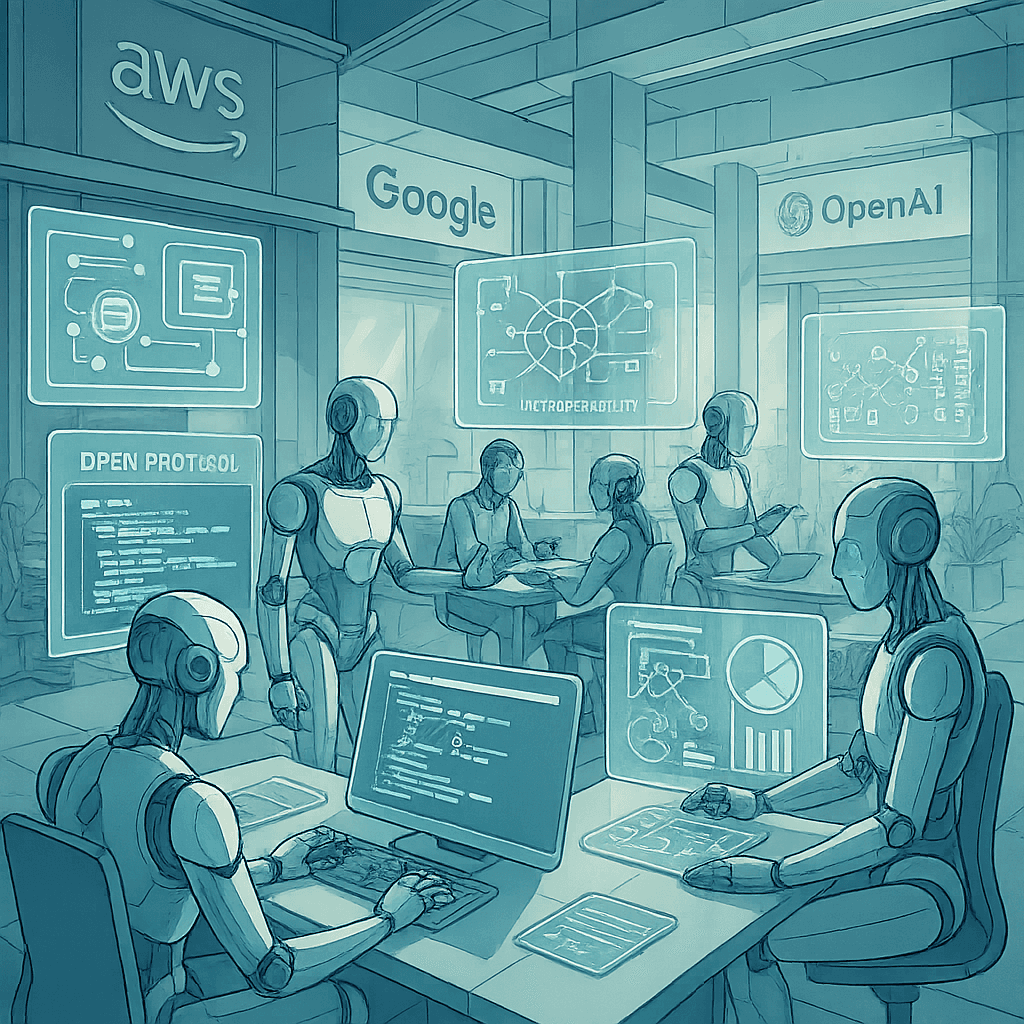
Picture a room with the biggest names in cloud, AI, and software—all joining hands to build the rails of tomorrow’s agentic future.
Platinum and key members named at launch include:
Amazon Web Services (AWS)
Anthropic
Block
Bloomberg
Cloudflare
Google
Microsoft
OpenAI (Linux Foundation Press Release; Intuition Labs Commentary)
But the doors are open wide: Startups, independent researchers, and other infrastructure companies are early participants as well (Intuition Labs Commentary; Data Intelligence Platform Report).
This mix of giants and newcomers is a signal. AAIF is not just for the titans—it’s designed as the essential base layer for everyone building or using agentic AI. By welcoming both the old guard and new innovators, AAIF hopes to energize the entire ecosystem.
The Technical Stack: How MCP, goose, and AGENTS.md Fit Together
Let’s imagine you want to build and deploy a real-world autonomous agent. Here’s how the AAIF projects stack up:
Describe Your Agent: Use AGENTS.md—write out everything your agent knows, does, and can access, in a machine-readable format.
Build and Orchestrate: Use tools and patterns from Block’s goose framework to put the agent together, coordinate its tasks, and manage workflows.
Connect to the World: When your agent needs to fetch data or trigger external APIs, it speaks MCP—the Model Context Protocol. This ensures every integration is open, auditable, and replaceable (building AI agents long term memory).
Because these are all open standards—hosted and evolved by AAIF—everyone else can use, improve, or swap out each piece. Suddenly, AI work moves from “island projects” to a bustling network of interoperable helpers.
Who’s in the Broader Agentic AI Landscape?
AAIF is just one piece of the puzzle. Other platforms and tools—like Google Agentspace, Microsoft’s AI Agents for Beginners, and OpenAI’s AgentKit—are also advancing the frontier of intelligent, autonomous systems. AAIF’s unique role is to make sure they all speak the same language.
Not to Be Confused: AAIF vs “Agentic AI Foundations” from AWS
Confusingly, Amazon Web Services has its own “Foundations of agentic AI on AWS” guidance—but it’s a different initiative (AWS Prescriptive Guidance).
AWS’s Document: Advice and patterns on how to deploy agentic architectures on AWS, with best practices for security, workflow, and operations.
AAIF’s Mission: Broader, cross-vendor, multi-platform standards so everyone everywhere can build and deploy agentic AI—on any cloud or on-prem, without lock-in.
These are complementary efforts—one focused on operational excellence in the AWS ecosystem, the other on making sure the entire industry speaks the same “agentic language.”
Where to Find AAIF Resources
The Digital Home
AAIF runs its official information hub at aaif.io. Here, you’ll find high-level overviews, news, and details on how to get involved or become a member.
Technical Assets and Community
Most of the heavy-lifting code and specifications live on GitHub, under the AAIF organization (Linux Foundation Press Release; AAIF Official Site). Current and future contributors can dive into:
Protocols (like MCP)
Schemas and Specification Docs (like AGENTS.md)
Reference Implementations
SDKs and Tools
Project Charters and Governance Documents
Contribution Guides
This open approach encourages anyone with an idea—or a bug fix!—to help steer the future.
The Road Ahead: Why the Agentic AI Foundation Will Shape Tomorrow
Why such excitement? In short: AAIF is laying the rails for the most significant new era in AI since deep learning made waves. Think about what came before: the web, email, Linux, smart devices—each transformed the world by agreeing on open standards. Now agentic AI, armed with proactive, autonomous systems, is on that same journey.
If you’re a business leader, you can safely begin future-proofing your tech landscape for agentic AI—with confidence that the pieces can fit together, no matter the vendor.
If you’re a developer, you have new, open “building blocks” to experiment, create, and share the next breakthrough agent—without hidden traps or blocked exits.
If you’re a user, you’ll soon see the benefits of agentic AI woven through life’s big and small moments—smarter helpers, safer automation, fairer access to intelligence.
AAIF’s open standards, neutral leadership, and broad support suggest the next wave of AI may be more like the open web than the closed platforms of the past—a thrilling prospect indeed.
Final Thoughts: Join the Journey!
Whether you’re a coder, a business strategist, a student—or just someone who loves following how the digital world is changing—it’s worth paying attention as AAIF gets started.
Visit aaif.io
Explore the open repositories and specs
Join the conversation, in person or online
Agentic AI is not just a new tool; it’s the dawn of a new kind of digital helper—open to all, driving shared benefit, and making the world more autonomous, intelligent, and connected.
Stay tuned for more thrilling developments in AI—right here, every week.
FAQ
What is the Agentic AI Foundation?
The Agentic AI Foundation (AAIF) is an initiative hosted by the Linux Foundation focused on creating open, transparent, and interoperable standards for autonomous AI agents, aiming to enable collaboration and prevent vendor lock-in.
How do the AAIF projects like MCP, goose, and AGENTS.md work together?
AGENTS.md is used to describe an agent’s capabilities, goose provides the orchestration framework to build and manage agents, and MCP enables those agents to communicate openly when accessing external tools or APIs, forming a modular and interoperable technical stack.
Who are the founding members of AAIF?
Founding members include leading tech companies such as Amazon Web Services, Anthropic, Block, Bloomberg, Cloudflare, Google, Microsoft, and OpenAI, among others including startups and independent researchers.
How is AAIF different from AWS’s “Foundations of agentic AI”?
AWS’s guidance focuses on deploying and securing agentic AI architectures specifically on AWS cloud. AAIF, in contrast, is a broader cross-vendor initiative working on open standards to enable interoperable autonomous AI agents anywhere, with no vendor lock-in.
Where can I learn more about AAIF and its resources?
Visit the official website at aaif.io for overviews, news, and membership info. Technical specifications and implementations are hosted on GitHub under the AAIF organization.