Written by : Chris Lyle
Dec 16, 2025

Estimated reading time: 26 minutes
Key Takeaways
AI intake for paralegals automates client onboarding, reducing bottlenecks and improving access to legal services.
Legal assistant automation tools leverage chatbots and intelligent workflows to capture, triage, and route client information efficiently.
Non-attorney legal chatbots provide 24/7 initial contact support without offering legal advice, maintaining compliance with UPL rules.
Document prep service intake AI streamlines accurate legal document preparation by validating and structuring client data.
Legal technician AI screening applies rule-based criteria to ensure compliance and assist human reviewers with eligibility and urgency flags.
Implementing AI solutions requires attention to integration, compliance, training, and ongoing human oversight to maximize benefits.
Table of Contents
Introduction: The New Era of AI Intake for Paralegals
Understanding AI Intake for Paralegals
Key Features and Benefits of Legal Assistant Automation Tools
Role and Advantages of Non-Attorney Legal Chatbots
Document Prep Service Intake AI: Simplifying Legal Documentation
Legal Technician AI Screening for Compliance and Efficiency
How to Implement AI Intake Solutions in Paralegal Firms
Future Trends and the Growing Role of AI in Paralegal Workflows
Conclusion: AI Intake for Paralegals Drives the Future of Legal Intake
FAQ
Introduction: The New Era of AI Intake for Paralegals
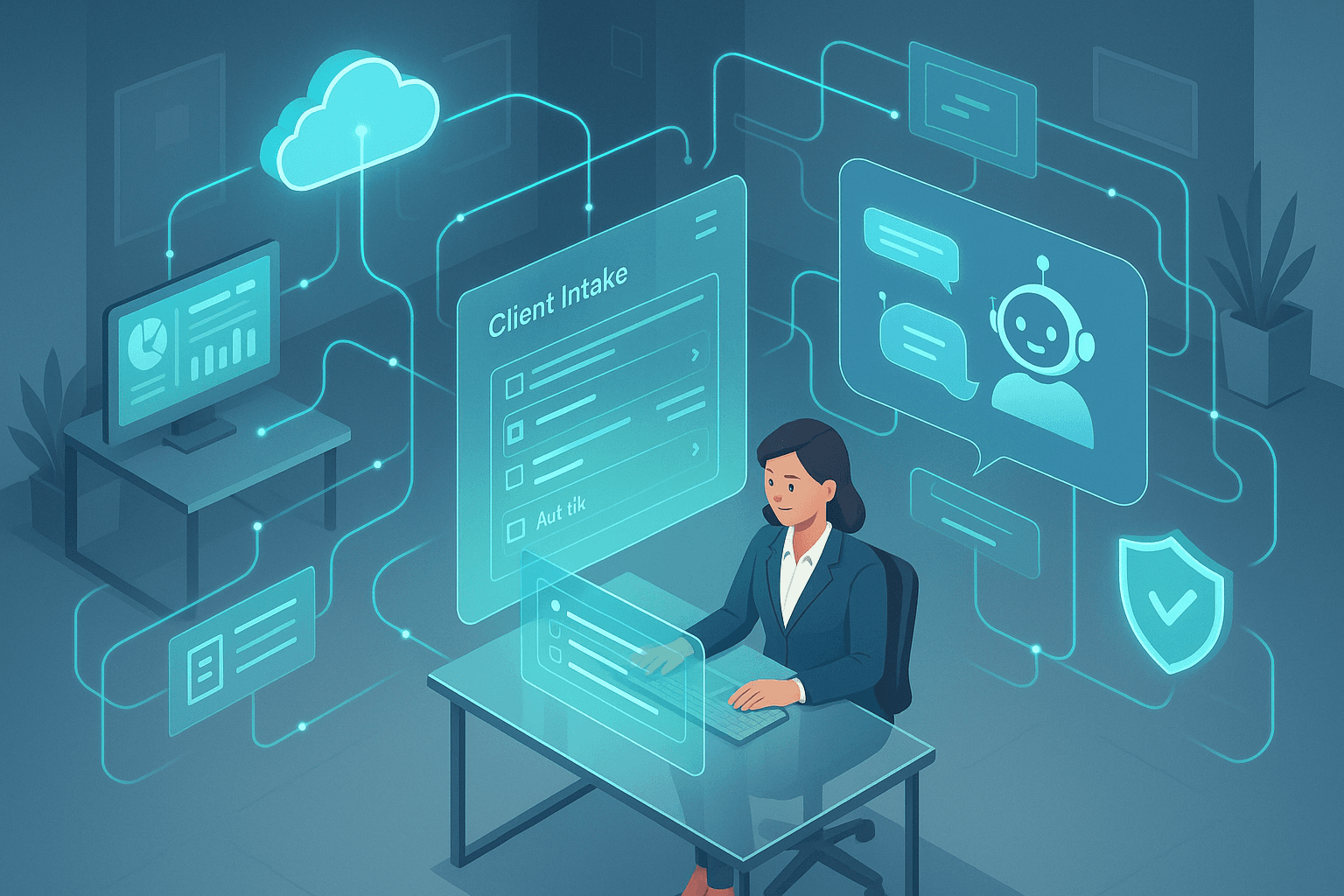
AI intake for paralegals is reshaping how law firms, legal document assistants, and non-attorney professionals onboard clients. Defined as the use of AI-driven tools—such as intelligent chatbots and workflow engines—AI intake for paralegals means delegating the initial intake tasks to automation: gathering client contact details, understanding the essence of their legal problem, and pre-screening relevant information before anything reaches a human reviewer (https://golawhustle.com/blogs/automated-legal-intake, Stanford, MyCase).
Why focus on intake? In many legal practices, the intake process poses a significant bottleneck, often impeding client access to crucial services. If clients cannot clear the intake hurdle, they are effectively locked out of legal help, regardless of merit (Stanford).
Today, a growing range of organizations deploy AI intake for paralegals, legal assistant automation tools, document prep service intake AI, non-attorney legal chatbots, and legal technician AI screening systems to streamline client onboarding. From large firms to nimble document preparation services, these solutions accelerate client intake and qualification (Filevine).
Critically, leading AI legal intake systems are built around compliance. These tools are deliberately programmed to support—but never replace—the sound legal judgment of licensed professionals. AI performs the repetitive, administrative heavy lifting; attorneys and qualified legal staff retain authority over all advice, case acceptance, and final decisions (https://golawhustle.com/blogs/ai-policy-for-law-firms, Stanford, MyCase).
Keywords used: AI intake for paralegals, legal assistant automation tools, document prep service intake AI, non-attorney legal chatbot, legal technician AI screening
Understanding AI Intake for Paralegals
What Is AI Intake for Paralegals?
AI intake systems are purpose-built software solutions leveraging automation, natural language processing (NLP), and rule-based decision-making to seamlessly guide new clients from their first contact through to an initial consultation or handoff (https://golawhustle.com/blogs/client-intake-form-law-firm, MyCase, Filevine). Their roles within paralegal and legal document assistant workflows include:
Structured Interviewing: Automated questioning built on scripted logic flows based on firm or agency criteria.
Record Generation: Creation of transcript-style applicant summaries for staff review, never a final case decision without human input (Stanford).
Seamless Data Flow: Integration with matter management and CRM tools to eliminate redundant data entry (MyCase, Filevine).
Distinctions Across Roles: Paralegals, Legal Document Assistants, and Legal Technicians
Paralegals: Frequently manage high-volume question-and-answer intake, early eligibility screening, and fact-gathering for attorney review but must never provide legal advice (https://golawhustle.com/blogs/paralegals-for-hire).
Legal Document Assistants: Operate in compliance with jurisdictional rules, often limited to document preparation and client communication, with no advice or advocacy.
Legal Technicians: Authorized in select states for defined types of client-facing services, but always within narrow scope regarding legal guidance.
All roles benefit from AI intake for paralegals through:
Automating repetitive Q&A, eligibility checking, and data collection
Reducing clerical errors and improving consistency
Freeing up staff to focus on higher-value review and client engagement
Keywords used: AI intake for paralegals, legal assistant automation tools, legal technician AI screening, document prep service intake AI, non-attorney legal chatbot
Key Features and Benefits of Legal Assistant Automation Tools
What Are Legal Assistant Automation Tools?
Legal assistant automation tools are digital solutions—often in the form of chatbots, intelligent forms, or built-in practice management integrations—designed to automate the intake, triage, and information-gathering work within legal workflows (https://golawhustle.com/blogs/ai-chatbot-for-law-firm-website, MyCase, Smokeball, Filevine).
Core Automation Benefits
Automated Data Capture
Dynamic, Intelligent Flows
Systems use NLP to understand the case type and dynamically tailor follow-up questions to the client’s answers using conditional logic (Stanford).
Intake Triage and Routing
Automated triage assesses whether the client’s issue is within practice scope and routes them to the correct team, clinic, or even offers referral to outside resources for out-of-scope needs (Filevine).
Faster Onboarding
Reduced missed connections and consistently applied screening improve efficiency and client satisfaction (Stanford).
Compliance and Security
Role-Based Access Controls
Compliance Guardrails
AI systems are trained to gather facts and route cases—not to make legal judgments or offer advice—upholding compliance with unauthorized practice of law (UPL) restrictions (Stanford, Thomson Reuters).
Benefits:
Reduced manual labor and errors
Consistent, unbiased intake screening
Improved data security and compliance adherence
Enables legal professionals to prioritize complex or billable work
Keywords used: legal assistant automation tools, AI intake for paralegals, document prep service intake AI, legal technician AI screening
MyCase
Smokeball
Filevine
Stanford
Thomson Reuters
Role and Advantages of Non-Attorney Legal Chatbots
What Are Non-Attorney Legal Chatbots?
Non-attorney legal chatbots are AI-powered agents that act as the initial point of contact for clients, typically via a firm’s website, mobile app, or through SMS channels. Unlike virtual legal assistants that focus on attorney support, these bots interact directly with prospective clients—gathering key intake data, answering basic procedural questions, and providing neutral, informational support (https://golawhustle.com/blogs/ai-chatbot-for-law-firm-website, Stanford, MyCase).
Core Functionalities
Basic Client Information Gathering
Collects core contact details and the essence of the legal issue, summarizing the scenario for further human review.
Procedural and Document Questions
Provides standard information on next steps or what documents clients may need, using pre-approved responses—never personalized legal advice.
Case Type Categorization & Routing
Uses NLP to interpret and classify broad legal issues (e.g., housing, consumer, immigration) for appropriate triage (Filevine).
24/7 Availability
Makes intake accessible round-the-clock, significantly improving access and client experience.
Compliance Boundaries
No Legal Advice
Chatbots are carefully programmed to provide generic information and never offer legal advice—ensuring firm compliance with UPL and role restrictions (Stanford).
Recommendation, Not Decision
Their output functions as a structured recommendation for human review. Only staff can affirm intake eligibility or case acceptance.
Impact:
Faster initial response times
Reduced bottlenecks during off-hours
Enhanced client satisfaction and engagement rates
Keywords used: non-attorney legal chatbot, AI intake for paralegals, legal assistant automation tools
Document Prep Service Intake AI: Simplifying Legal Documentation
What Is Document Prep Service Intake AI?
Document prep service intake AI uses AI-powered platforms to collect the detailed, structured client information needed to populate standardized legal documents. This innovation enables document preparation services and legal document assistants to efficiently and accurately prep paperwork for filings, letters, and court forms.
How It Works
Smart Questionnaire Engine
Data Validation and Completeness Checks
AI systematically verifies that required fields, such as case dates, parties, or applicable jurisdictions, are included and highlighted if missing.
Automated Document Templates
Workflow Benefits
Reduces Missing Information
With built-in field validation, errors or gaps that trigger back-and-forth follow-up are minimized.
Improves Efficiency
Quicker turnaround for client documents, freeing staff for higher-level tasks.
Empowers Staff
Paralegals can focus on issue spotting, escalation, and quality control rather than monotonous data entry (NALA).
Keywords used: document prep service intake AI, AI intake for paralegals, legal assistant automation tools
Stanford
MyCase
Filevine
NALA
Smokeball
Legal Technician AI Screening for Compliance and Efficiency
What Is Legal Technician AI Screening?
Legal technician AI screening involves AI solutions programmed to apply specified program or agency eligibility rules and decision-trees—never independent legal judgment—to assess whether a matter fits within service scope or to flag critical issues for subsequent human review (Stanford, Filevine, Thomson Reuters).
Example in Practice
Eligibility Interviews
Intake AI asks standard questions—such as income, residence, and case type—for legal aid program screening (Stanford).
Urgency Flagging
AI flags urgent issues (e.g., "eviction/lockout – urgent") while still requiring a human to review and decide on next steps.
Preliminary Matching
AI may suggest when a client "might qualify" for a resource or defense, but ultimate acceptance or recommendations remain human duties.
Compliance and Best Practices
Rule Application, Not Advice
The AI’s scope is to apply intake criteria, not to perform legal analysis or advice (Thomson Reuters).
Human in the Loop
Staff attorneys or legal professionals make all final decisions—a requirement for UPL avoidance and recognized best practice (Stanford).
Benefits:
Improved consistency and neutrality in screening
Early escalation of complex or urgent issues
Supports high-volume legal help programs
Keywords used: legal technician AI screening, AI intake for paralegals, legal assistant automation tools
Stanford
Filevine
Thomson Reuters
How to Implement AI Intake Solutions in Paralegal Firms
1. Tool Selection
Integration & Customization
Security Features
Choose systems with robust encryption, role-based access, audit logs, and secure data hosting (Smokeball).
2. Workflow Design
Map and Analyze
Examine your current intake process: staff roles, client questions, eligibility flows (Stanford).
Automation vs. Oversight
Decide which steps benefit from automation (generic Q&A, appointment scheduling, data capture) and which mandate human judgment (legal advice, case acceptance).
Pilot and Refine
Start with a subset (like a single practice group or form type), test, and improve based on real staff feedback.
3. Compliance and Data Protection
Regulatory Alignment
Ensure all AI scripts, chatbots, and workflow engines strictly adhere to UPL and paralegal/document assistant rules in your jurisdiction.
Data Ownership and Access
Establish clear policies around ownership of client intake data, staff access permissions, and required human approval for critical actions.
Confidentiality
Maintain confidentiality, professional responsibility, and retention standards for all client data.
4. Training and Supervision
Active Oversight
Train intake and paralegal staff to review, correct, and escalate AI outputs—ensuring quality and compliance (NALA, Brightflag).
Continuous Improvement
Create feedback loops so workflows are always kept up to date and tuned to evolving practice needs.
Checklist:
Select secure, integrated tools
Map and automate appropriate intake steps
Align with ethical/legal requirements
Train staff and maintain ongoing oversight
Keywords used: AI intake for paralegals, legal assistant automation tools, non-attorney legal chatbot, document prep service intake AI, legal technician AI screening
MyCase
Smokeball
Stanford
MyLegalSoftware
Thomson Reuters
NALA
Brightflag
Future Trends and the Growing Role of AI in Paralegal Workflows
The Rise of Agentic AI and Technology-Driven Paralegals
With rapid advances in artificial intelligence, legal sector organizations anticipate broader adoption of "agentic" AI—systems capable of executing complex multi-step intake, summarization, scheduling, and case routing, all under vigilant human oversight (Thomson Reuters).
Predictions and Opportunities
Deeper System Integrations
Expect AI intake, e-signature, document automation, and court e-filing systems to become tightly integrated for full end-to-end process automation.
Paralegals as Tech Champions
Enhanced Ethics and Guardrails
Regulatory sandboxes and clearer compliance frameworks will make broader use of AI—and non-attorney roles—feasible, while ensuring confidentiality and reducing bias (Thomson Reuters).
Ongoing Challenges
Maintaining the "Human in the Loop": As AI intake for paralegals becomes more autonomous, strong oversight remains essential to protect client interests.
Ethical and Regulatory Compliance: Bar associations and regulators are updating guidance, ensuring the safe participation of AI and non-lawyer professionals in legal services.
Keywords used: AI intake for paralegals, legal assistant automation tools, non-attorney legal chatbot, document prep service intake AI, legal technician AI screening
Conclusion: AI Intake for Paralegals Drives the Future of Legal Intake
AI intake for paralegals is not just a passing trend—it is a defining transformation for firms, legal document assistants, and non-attorney legal professionals. The latest generation of legal assistant automation tools, non-attorney legal chatbots, document prep intake AI, and legal technician AI screening systems are streamlining what was once the most challenging, repetitive, and error-prone stage in legal service delivery (NALA, MyCase, Filevine).
By embracing these solutions—with strong compliance, security, and human oversight—legal teams free up their paralegals and assistants to focus on higher-order, client-facing, and analytical tasks. This shift enhances both the speed and quality of client service, opens the legal system to more clients, and lets professionals operate at the top of their credentials (Brightflag, Clio).
Ready to bring the power of AI intake for paralegals to your practice? Book a live demo of LawHustle today and discover how these tools can supercharge your workflow, boost compliance, and let your staff focus on what matters most.
Keywords used: AI intake for paralegals, legal assistant automation tools, non-attorney legal chatbot, document prep service intake AI, legal technician AI screening
NALA
MyCase
Filevine
Brightflag
Clio
FAQ
What is AI intake for paralegals?
AI intake for paralegals refers to AI-driven tools and systems that automate the client intake process in legal environments, including data collection, eligibility screening, and workflow management, all designed to assist paralegals and legal staff while preserving human oversight.
How do legal assistant automation tools improve intake?
These tools use intelligent chatbots, forms, and workflows to capture client information accurately, dynamically tailor interview questions, route cases efficiently, and reduce manual entry errors, all while maintaining compliance and data security.
Can non-attorney legal chatbots provide legal advice?
No. Non-attorney legal chatbots are programmed to offer neutral, procedural information only and never provide personalized legal advice, ensuring compliance with unauthorized practice of law (UPL) regulations.
What are the benefits of legal technician AI screening?
Legal technician AI screening enhances consistency in eligibility assessments, flags urgent issues early, reduces human error, and supports legal professionals by automating rule-based intake criteria while ensuring human decision-making remains central.
How can paralegal firms implement AI intake solutions effectively?
Firms should select AI tools compatible with their existing systems, ensure compliance with regulations, map workflows for automation vs. human oversight, provide training for staff to supervise AI outputs, and maintain continuous feedback for process improvement.