Written by : Chris Lyle
Nov 24, 2025

Estimated reading time: 14 minutes
Key Takeaways
AI objection handling legal intake revolutionizes client onboarding by automating responses to common client hesitations, enhancing trust and conversion.
Legal intake objection resolution AI offers advanced features such as NLP understanding, real-time escalation to humans, and seamless integration with existing systems.
Smart hesitation response chatbots improve client experience by providing instant, empathetic, and situation-specific answers around the clock.
Implementing AI-driven legal intake increases efficiency, consistency, professionalism, and enables data-driven continuous improvement.
Choosing the right AI tools requires evaluating comprehensive objection coverage, integrations, customization, security, and usability for your firm’s needs.
AI-powered objection management is becoming a competitive necessity for law firms aiming to reduce lead drop-off and accelerate case intake.
Table of Contents
Introduction: Transforming Legal Intake with AI Objection Handling
Understanding Client Objections in Legal Intake
How AI Enhances Objection Handling in Legal Intake
Smart Responses to Client Hesitations with AI Chatbots
Benefits of Implementing AI Objection Handling in Legal Intake
Considerations When Choosing AI Tools for Legal Objection Handling
Conclusion: The Next Frontier in Legal Client Onboarding
References
FAQ
Introduction: Transforming Legal Intake with AI Objection Handling
The landscape of legal client intake is changing rapidly—and AI objection handling legal intake is at the forefront of that transformation. Today, law firms are harnessing the power of legal intake objection resolution AI and smart hesitation responses legal chatbot solutions to automate, manage, and enhance how they react to prospective client hesitations. This advanced approach enables effective AI concern management legal funnel strategies that optimize client trust and boost conversion rates (MyCase, Filevine).
Effectively managing objections during legal intake is mission-critical. Every question, concern, or objection voiced by a potential client shapes their perception of a law firm. How firms handle these critical moments not only determines whether clients proceed with your services—it directly influences firm reputation, trustworthiness, and long-term success (MyCase).
AI-powered tools are increasingly relied on to automate and optimize objection handling, thanks to their ability to:
Respond instantly to common legal hesitations
Interpret and resolve nuanced concerns
Escalate complex queries to human team members as needed
Ensure consistency, professionalism, and compliance at every stage
In this blog, we’ll explore the challenges of client objections in legal intake, the advantages of AI-driven solutions, how smart rebuttal bots work, key benefits, and practical factors for choosing the right AI tools for your law firm.
Source: MyCase | Source: Filevine
Understanding Client Objections in Legal Intake
The Role of AI Objection Handling Legal Intake in Addressing Common Client Concerns
Client objections are a fundamental part of legal intake. Law firms often encounter a range of hesitations during the first touchpoint with new prospects. AI objection handling legal intake and robust AI concern management legal funnel solutions are designed to address these issues, but understanding the root objections is essential.
Most Common Objections During Legal Intake
Questions about legal costs: Prospective clients routinely express anxiety about fees, billing transparency, and potential hidden costs.
Concerns over privacy and data security: Many individuals worry if their sensitive legal and personal information will remain confidential.
Uncertainty about case eligibility: Potential clients often do not know if their situation qualifies as a case worth pursuing.
Confusion with legal process complexity: The legal world is intimidating; clients may hesitate due to unfamiliarity with steps, duration, or outcomes.
Apprehension about timely responses: Slow or unclear responses from law firms breed mistrust and lost opportunities.
Why Swift Objection Management Matters
Proper handling of objections during intake:
Increases likelihood of converting qualified leads
Sets a foundation of trust and credibility
Prevents damage to firm reputation from poor first impressions
In contrast, inefficient or delayed responses can cause leads to disengage, seek another firm, or leave negative reviews. Learn more about AI for lawyers
Challenges of Manual Objection Handling
Traditionally, managing intake objections has depended on staff availability, expertise, and manual processes, yielding:
Inconsistencies in messaging: Different staff members may deliver variable, incomplete, or even incorrect information.
Slow follow-up: Manual back-and-forth leads to bottlenecks, delays, and missed opportunities.
Attorney time drain: Valuable attorney or paralegal time is spent on repetitive queries, not high-value work.
Reduced efficiency: All of the above can hurt the client experience and hinder firm growth.
How AI Enhances Objection Handling in Legal Intake
Elevating Client Rebuttal Automation and Legal Intake Objection Resolution AI
With client rebuttals automation attorneys, AI becomes the engine behind instant, context-aware, and dependable answers to intake objections. The impact is transformative, both for the law firm’s workflow and the prospect’s journey.
What Is Client Rebuttals Automation for Attorneys?
This technology allows law firms to leverage artificial intelligence—especially smart chatbots and guided forms—to:
Instantly recognize hesitations, questions, or objections in client communications
Respond with accurate, empathetic, and legally sound information 24/7
Route complex or sensitive queries to human team members in real time
Top Features of Legal Intake Objection Resolution AI
Advanced NLP (Natural Language Processing): AI scans for both intent and emotion, ensuring clients are understood, not just processed.
Automated qualification and triage: Potential cases are sorted, prioritized, and routed based on probability of success, practice area, or urgency, using data-driven logic.
Real-time escalation: When an objection or query exceeds the AI’s remit (e.g., complex legal nuance, heightened sensitivity), the conversation seamlessly transitions to a human.
CRM and intake system integrations: AI tools connect directly with the broader intake, case management, and calendaring ecosystems, streamlining data capture and workflow.
Behavioral analytics: Every interaction is logged and analyzed, surfacing trends in objections and guiding improvement to scripts and workflows.
(MyCase, Checkbox.ai, Checkbox.ai)
AI Concern Management in the Legal Funnel
AI objection handling legal intake solutions track and resolve hesitations at every funnel stage by:
Capturing and logging each client’s unique concerns
Delivering consistent, evidence-backed answers
Identifying where clients “stall” due to unresolved doubts
Triggering nudges or escalation when indecision lingers
This holistic concern management ensures objections don’t halt progress toward onboarding and retainer signature.
Smart Responses to Client Hesitations with AI Chatbots
Mastering Smart Hesitation Responses with Legal Chatbot Technology
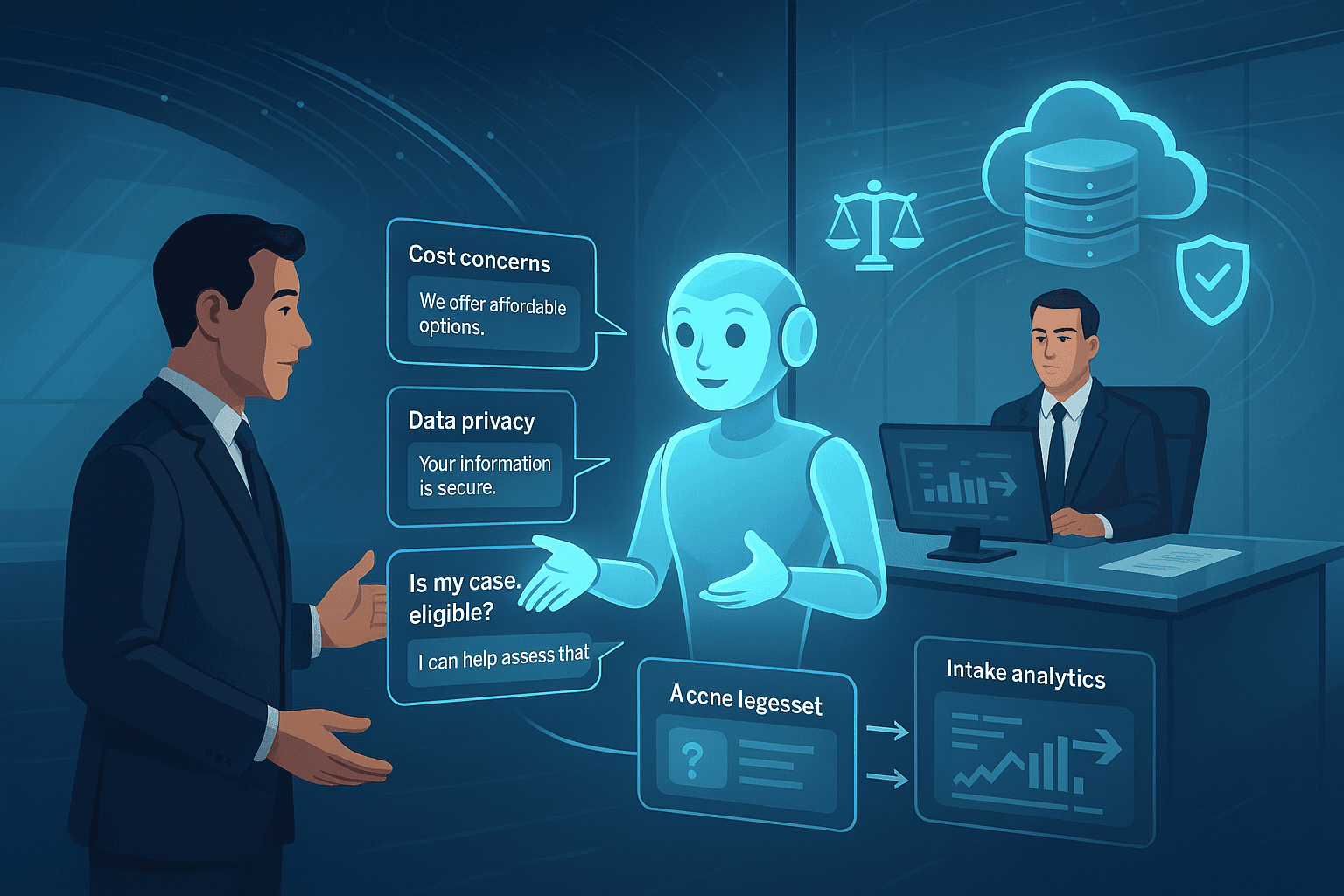
Smart hesitation responses legal chatbot solutions are at the heart of modern legal intake automation. These AI-powered chatbots recognize client uncertainty and seamlessly provide precise, empathetic, and actionable answers.
How Do Smart Hesitation Response Chatbots Work?
NLP-Powered Detection: The chatbot interprets written (or spoken) client messages for sentiment and intent—spotting uncertainty, confusion, or direct objections.
Instant, context-aware clarification: On recognizing an objection (e.g., “Is this confidential?” or “How does billing work?”), the chatbot draws from a predefined knowledge base to deploy clear, concise, and compliant explanations.
Real-time eligibility evaluation: For practice areas like personal injury, employment, or family law, the bot asks qualifying questions and provides immediate, situation-specific responses.
Next-step facilitation: If an objection cannot be immediately resolved or signals readiness, the chatbot prompts the client to book a consultation, upload documents, or escalate to a case manager.
Practical Scenarios with Smart Legal Chatbots
Privacy concern: Client types, “Is my information safe?” The chatbot assures them of the firm's encryption, regulatory compliance, and confidentiality protocols.
Case eligibility confusion: Client asks if their injury or situation qualifies. The chatbot takes them through eligibility questions; if borderline, it offers to schedule a consult for more precise advice.
Process uncertainty: Client seems unsure about next steps. The chatbot outlines a step-by-step intake and onboarding guide, demystifying the process in plain language.
Cost hesitation: When a prospect inquires about fees, the chatbot lists transparent pricing models, possible contingency arrangements, and links to helpful resources.
Conversion, Trust, and 24/7 Support
Smart hesitation responses legal chatbots:
Create instant rapport by offering tailored, empathetic rebuttals
Keep leads engaged by not allowing objections to linger
Operate round-the-clock—supporting inquiries after hours and on weekends
Ensure every potential client receives consistent, professional handling, regardless of staff workload
Benefits of Implementing AI Objection Handling in Legal Intake
Unlocking the Value of Client Rebuttals Automation Attorneys and Legal Intake Objection Resolution AI
Adopting AI-driven objection management in legal intake brings measurable advantages to both clients and law firms. Here’s what research and field experience confirm:
Increased Efficiency
Objection rebuttal automation via AI instantly addresses repetitive, low-complexity queries, freeing attorneys and paralegals to focus on complex, high-value tasks.
Supports higher lead volumes without sacrificing quality or response time.
Accelerates qualification, triage, and onboarding, shortening the sales cycle.
Consistency and Professionalism
AI ensures standardized tone, accuracy, and compliance in every response—cutting down on risk from inconsistent or off-brand messaging.
Maintains adherence to legal protocols in addressing confidential and regulated topics.
Improved Client Experience and Conversion
Prospective clients get immediate, relevant, and clear answers, building trust and confidence during the decision phase.
Reduction in client drop-off and “ghosting” as objections are resolved before clients look elsewhere.
Smoother, more engaging intake processes lead to increased onboarding rates.
Data-Driven Process Improvement
AI tracks, logs, and analyzes every objection interaction, surfacing bottlenecks and common hesitations.
Firms can refine chatbot scripts, FAQs, website copy, and even attorney training based on actionable insights.
Considerations When Choosing AI Tools for Legal Objection Handling
Legal Intake Objection Resolution AI: Must-Have Features & Evaluation Criteria
With new vendors and solutions emerging rapidly, it’s vital for law firms to select the most suitable AI-powered intake tools for their unique needs. Here are essential requirements for legal intake objection resolution AI, client rebuttals automation attorneys, and related solutions.
Criteria for Selecting the Right AI Legal Intake Solution
Comprehensive objection coverage: The system should address a wide array of common legal hesitations—billing, confidentiality, process, case qualification—with minimal manual intervention.
(MyCase)
Seamless integrations: Integration with your existing CRM, case management, document storage, calendaring, and intake pipelines is critical for workflow automation and data integrity.
Customization to practice area: Whether serving personal injury, immigration, employment, or corporate law, the AI must be trainable for your domain’s unique terminology, processes, and common objections.
Legal-specialized NLP: Off-the-shelf chatbots often struggle with legal nuance; look for AI tuned for complex, regulatory subjects and jurisdictional variations.
Privacy, security, and AI ethics compliance:
AI disclosure: Be transparent with clients when they’re interacting with an AI.
Data encryption and secure access controls: Protect all client data per local privacy regulations and legal industry best practices.
Confidentiality protocols: Ensure the AI never discloses sensitive matters, or escalates to human review when in doubt.
Escalation and notification workflows: When complex or sensitive issues arise, the AI should flag that human attention is needed, transfer the conversation, and notify the client.
(MyCase)
Analytics and reporting: Choose solutions with rich dashboards that report on objections resolved, conversion rates, and dropout causes—enabling continuous improvement.
Deployment and User Experience
Ease of implementation: Intuitive UI/UX for both staff and clients, with minimal technical overhead for onboarding.
Scalability: Ability to handle spikes in intake without sacrificing quality.
Language support: Multilingual capabilities, if serving diverse populations.
Mobile responsiveness: Ensure AI chatbots and forms are optimized for smartphones and tablets.
Conclusion: The Next Frontier in Legal Client Onboarding
AI is fundamentally changing how law firms respond to client concerns and objections. AI objection handling legal intake platforms are allowing firms to manage prospective client hesitations, deliver consistent and accurate information, and speed up onboarding—all while freeing human staff for complex and high-value work.
Implementing client rebuttals automation attorneys and smart hesitation responses legal chatbot solutions is quickly becoming a competitive necessity for modern law firms. Early adopters are seeing reduced lead drop-off, faster case intake, higher client satisfaction, and improved efficiency (MyCase, Filevine, Eve Legal).
Don’t wait to see your competitors leap ahead—explore how AI-powered objection management can help your practice build more productive client relationships and sustainably grow your business.
Ready to see how LawHustle’s AI intake solutions can advance your practice? Book a demo today and discover the power of intelligent objection handling tailored for law firms.
References
FAQ
What is AI objection handling legal intake?
It is an AI-powered process or platform that helps law firms automate the management and resolution of client objections during the intake phase, improving responsiveness, trust, and conversion rates.
How do smart hesitation response chatbots benefit law firms?
They detect client uncertainty using natural language processing and provide instant, context-aware, and legally accurate answers, reducing delays and improving client satisfaction and onboarding rates.
What should law firms consider when choosing AI legal intake tools?
Key criteria include comprehensive objection coverage, integrations with existing systems, customization for practice area, security and ethical compliance, ease of use, scalability, and analytics capabilities.
Can AI tools escalate complex legal questions to human staff?
Yes. When an objection or query surpasses the AI’s scope, robust solutions trigger seamless escalation to qualified human team members to ensure accurate handling.
How does AI improve efficiency in legal client intake?
By automating responses to routine objections, triaging cases, and providing 24/7 support, AI reduces attorney workload, speeds up onboarding, and increases capacity without sacrificing quality.