Written by : Chris Lyle
Nov 21, 2025

Estimated reading time: 16 minutes
Key Takeaways
Personalized timing driven by AI significantly improves legal lead follow-up effectiveness and conversion rates.
AI models analyze behavioral, temporal, and engagement data to predict optimal outreach windows.
Temporal behavior AI legal intake provides granular insights that maximize client responsiveness based on interaction timing.
Lead re-engagement time optimization reduces outreach fatigue by targeting prospects only when showing renewed interest.
AI-driven timing delivers higher conversions, greater resource efficiency, and enhanced client experience.
Practical implementation requires suitable AI platforms, firm-specific data training, compliance adherence, and team education.
Table of Contents
Introduction: Harnessing AI Timing Prediction Legal Leads for Law Firms
Why Timing Matters in Legal Lead Follow-Up: Best Time to Follow Up Law Prospects
How AI Models Improve Legal Lead Follow-Up: Legal Follow-Up Timing AI Model
Exploring Temporal Behavior AI in Legal Intake Processes
Lead Re-Engagement Time Optimization for Legal Services
Benefits of Using AI-Driven Timing Prediction for Legal Leads
Case Studies and Real-World Examples: AI Timing Prediction Legal Leads in Action
Practical Steps for Law Firms to Implement AI Timing Prediction
Conclusion: AI Timing Prediction Legal Leads—The Competitive Edge for Modern Law Firms
FAQ
Introduction: Harnessing AI Timing Prediction Legal Leads for Law Firms
Converting legal leads is a race against time. AI timing prediction legal leads refers to using artificial intelligence to forecast the precise moments when a legal prospect is likeliest to answer, respond, or convert. For law firms, pinpointing the best time to follow up law prospects is an emerging competitive edge: outreach is most effective when it matches the prospect’s actual readiness. Instead of guessing or relying on intuition (https://golawhustle.com/blogs/ai-powered-lead-generation), firms now leverage behavioral and temporal data to engage legal leads at the right moment, vastly improving conversion rates and marketing ROI.
Temporal behavior AI legal intake tools have transformed the client acquisition process (https://golawhustle.com/blogs/automated-legal-intake). Instead of blind outreach, firms now use data-driven insights from AI lead management systems to schedule calls, texts, and emails when prospects are most likely to respond (https://golawhustle.com/blogs/ai-lead-management). In this article, we’ll explore:
Why timing is critical for legal prospect follow-up
How AI models personalize outreach based on data
The role of temporal and behavioral analysis in intake
Strategies and best practices for law firms adopting these tools
By the end, you’ll understand how to optimize your legal intake and beat the competition with actionable, AI-powered timing strategies.
Sources:
https://lawpronation.com/ai-law-firm-marketing-strategies/
https://firmpilot.com/blog/ai-for-legal-marketing/
Why Timing Matters in Legal Lead Follow-Up: Best Time to Follow Up Law Prospects
Prospective clients contact law firms with urgent, sensitive, and sometimes emotional needs. Their path is rarely linear—they research, compare, and contact multiple firms. This context makes precise follow-up timing absolutely critical.
The Mindset of Legal Prospects
High urgency: Most legal leads need help fast (personal injury, criminal law, family matters).
Multiple inquiries: Clients often reach out to several firms for guidance.
Sensitive decision-making: The situations are rarely casual; prospects seek trust and competence quickly.
Conventional Follow-Up Pitfalls
Fixed outreach windows: Following up at the same time for all leads is a relic of the past.
Batch timing: Sending bulk emails or calls at predictable times ignores each client’s unique behaviors.
Static “best practices”: A one-size-fits-all “best time” leads to missed opportunities (https://golawhustle.com/blogs/automated-client-follow-up).
The Real-World Impact
Too late: If a follow-up arrives even a few hours after a prospect’s “moment of need,” the opportunity may vanish—they may have already hired another attorney.
Too early: Contacting before the prospect is ready can cause disengagement or annoyance.
Lost conversions: Studies show that 50% of legal leads go with the first firm to respond appropriately.
Key Insight:
There is no universal “best time to follow up law prospects.” Only personalized timing—driven by data—consistently outperforms.
Sources:
https://lawpronation.com/ai-law-firm-marketing-strategies/
https://firmpilot.com/blog/ai-for-legal-marketing/
How AI Models Improve Legal Lead Follow-Up: Legal Follow-Up Timing AI Model
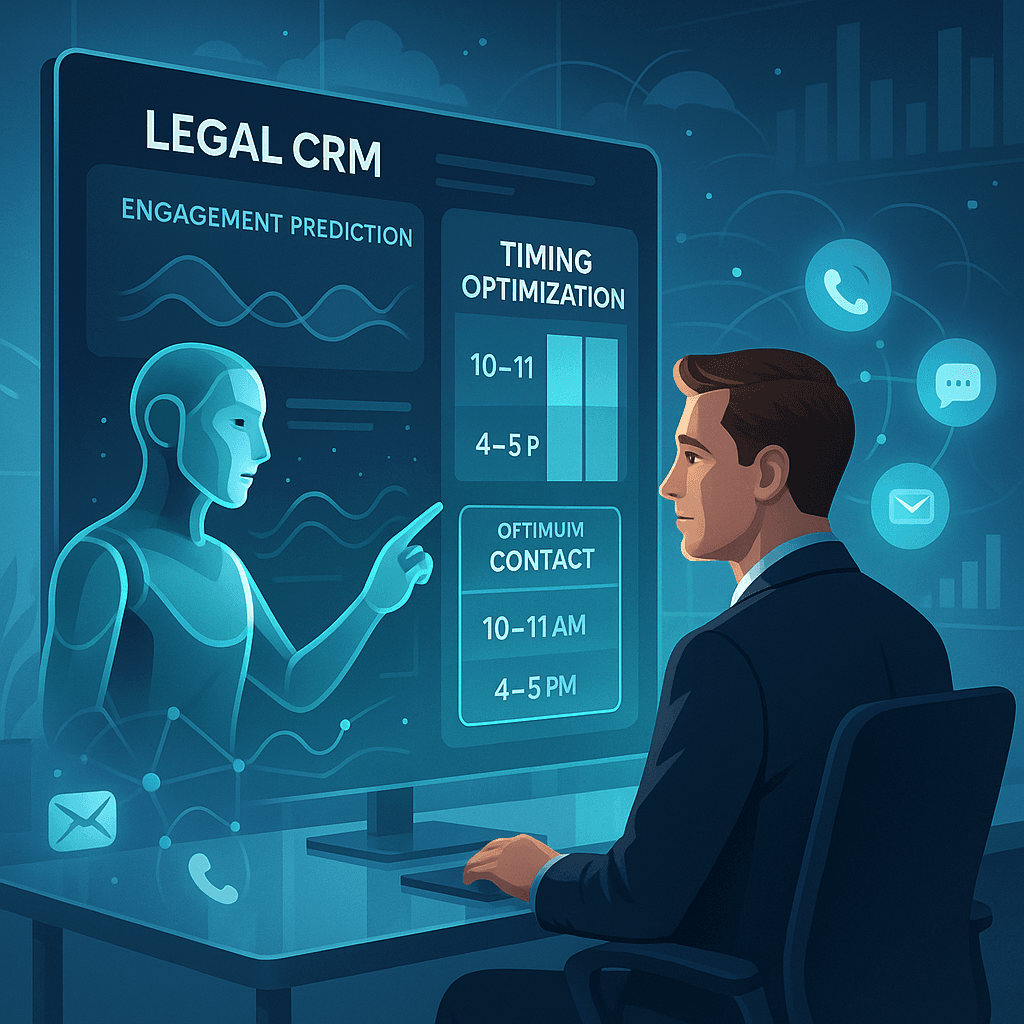
What is a legal follow-up timing AI model? It’s an artificial intelligence system that analyzes massive datasets about every step of your prospect’s engagement to predict when you should reach out (https://golawhustle.com/blogs/ai-marketing-for-attorneys).
Anatomy of a Legal Follow-Up Timing AI Model
Historical response times: The model tracks when prospects have historically responded—by time of day, day of week, or even within minutes of various events.
Engagement behaviors: Email opens, website visit timestamps, chat activity times—all offer critical signals.
Contact patterns: Does a prospect fill out web forms at midnight or at lunchtime? Do they answer texts before commuting or only after work?
Continuous learning: As the AI gathers more client-specific and aggregate data, its predictions become even sharper.
Operational Flow
Data is collected from CRM, website, email, SMS, and chat history.
The AI model analyzes and identifies precise windows where prospects are most receptive.
Outreach (emails, calls, texts) is either suggested to staff or automatically triggered at the most likely conversion moment.
Why is this so powerful?
Because AI timing prediction legal leads removes the guesswork and intuition that lead to lost cases and wasted intake efforts.
Sources:
https://www.mycase.com/blog/ai/ai-marketing-law-firms/
https://lawpronation.com/ai-law-firm-marketing-strategies/
https://firmpilot.com/blog/ai-for-legal-marketing/
Exploring Temporal Behavior AI in Legal Intake Processes
Keyword Focus: temporal behavior AI legal intake
Temporal behavior AI legal intake is a specialized application of AI that interprets the timing of every action prospects take during their intake journey. It goes beyond static, demographic data to analyze when clients interact—turning those insights into actionable timing for follow-up (https://golawhustle.com/blogs/automated-legal-intake).
How Temporal Behavior AI Analyzes Intake
Form submission timestamps: Did the potential client request a consultation at 12:30 PM or 7:00 PM?
Time-of-day engagement: Do some segments reply fastest to outreach in the early evening, others in the early morning?
Response latency: How long after the initial website visit did the prospect become active, and when did they open follow-up communications?
Scenario Examples
Lunchtime form fills: Prospects filling forms between noon–1 PM are shown (by AI) to respond to texts within 10 minutes—an instant outreach leads to high conversions.
Evening inquiries: Submissions at 8 PM are best engaged with next-morning emails.
Weekend demographics: Certain age groups or case types interact with chatbots predominantly Saturday and Sunday mornings.
Content-driven triggers: When a prospect downloads a critical FAQ or views an educational video, it signals a readiness spike—timed outreach then leads to immediate engagement.
By continuously learning from actual, behavioral time patterns rather than adhering to generic schedules, legal follow-up timing AI models and temporal behavior AI legal intake platforms ensure that every follow-up is delivered at the moment of highest receptivity.
Sources:
https://lawpronation.com/ai-law-firm-marketing-strategies/
https://www.mycase.com/blog/ai/ai-marketing-law-firms/
Lead Re-Engagement Time Optimization for Legal Services
Keyword Focus: lead re-engagement time optimization legal
Most prospects aren’t ready to immediately hire; they may browse, hesitate, or choose to wait. Traditionally, firms tried to re-engage by sending out recurring batch messages—often ignored, sometimes resented, and rarely effective (https://golawhustle.com/blogs/ai-powered-lead-generation).
Defining Lead Re-Engagement Time Optimization Legal
Lead re-engagement time optimization legal means using artificial intelligence to:
Detect when a dormant or unresponsive lead is once again showing “buy signals.”
Decide when and how to reach out for maximum acceptance and minimum fatigue.
Avoid spammy, repetitive attempts in favor of context-driven communication.
Core Re-Engagement Strategies Powered by AI
Behavior-driven triggers:
- Lead returns to the site
- Downloads a new case study
- Opens an older email after a period of inactivity
Action: Instantly trigger a personalized reminder, not a generic batch message.Outreach pauses: The AI automatically holds off follow-up during inactivity, preventing lead burnout.
Education at the right time: When the AI senses rising curiosity (frequent FAQ visits, resource downloads), it sends targeted materials to nurture the lead gently forward.
Impact:
Lead re-engagement time optimization legal efforts translate to less wasted time and more conversions from prospects who may otherwise fall through the cracks.
Sources:
https://lawpronation.com/ai-law-firm-marketing-strategies/
https://www.mycase.com/blog/ai/ai-marketing-law-firms/
Benefits of Using AI-Driven Timing Prediction for Legal Leads
Keyword Focus: AI timing prediction legal leads
Law firms that embrace AI timing prediction for legal leads unlock measurable, data-backed advantages.
Major Benefits
Dramatically Higher Conversion Rates:
- Outreach lands when the prospect is eager, leading to more booked consultations and case signups.
- Firms using AI-driven timing have reported 2–4x increases in contact-to-client conversion rates.Resource Efficiency:
- Staff aren’t cold-calling or emailing at dead times; instead, they focus outreach on warm, responsive leads (https://golawhustle.com/blogs/crm-for-law-firms).
- Marketing spend is funneled into high-intent prospects, driving down cost per client acquisition.Enhanced Client Experience:
- Prospects receive timely, relevant communication—not generic or mistimed pitches.
- Responsive, context-aware service builds trust, distinguishes the firm, and yields more positive reviews and referrals.Decreased Lead Attrition:
- Few leads are lost to competitor firms due to delayed or misplaced follow-up.
- AI monitoring ensures no prospect is neglected—each is contacted when it matters most.
Direct Results from AI Lead Re-Engagement Time Optimization Legal
Research and real-world data confirm that lead re-engagement time optimization legal, when powered by AI, yields:
25–50% upticks in return prospect conversions versus batch or arbitrary outreach
Reduced “no-action” rates among previously dormant leads
Sources:
https://lawpronation.com/ai-law-firm-marketing-strategies/
https://firmpilot.com/blog/ai-for-legal-marketing/
https://www.mycase.com/blog/ai/ai-marketing-law-firms/
Case Studies and Real-World Examples: AI Timing Prediction Legal Leads in Action
Nothing demonstrates the power of AI timing prediction legal leads like real-world results.
FirmPilot Success: Automated Golden Window Engagement
Challenge: A mid-sized injury law firm was missing 40%+ of leads.
Solution: Implemented FirmPilot’s legal follow-up timing AI model, which triggered follow-up within minutes of form submissions.
Result: 3x increase in consultation bookings and a 60% decrease in leads lost to competitors.
Learn more about FirmPilot’s AI model
Rapid Response Retention: Personal Injury Firm Example
Scenario: Before AI, retention from web forms was just 15%.
Action: AI-driven system triggered text messages within 15 minutes of each new lead engagement.
Outcome: Retention rate jumped to over 40%, with significantly higher client satisfaction scores.
AI Platforms Drive Better Consultations
Numerous law firms using AI-enabled CRMs like MyCase, Clio, and FirmPilot are reporting:
Response times to leads reduced from hours/days to mere minutes
Higher engagement rates as outreach is no longer random, but precisely timed
Dramatically fewer leads falling through the cracks, as AI identifies optimal contact points
Clients emphasize that the legal follow-up timing AI model not only boosts conversions but also reduces the need for intrusive, high-volume follow-ups.
Sources:
https://firmpilot.com/blog/ai-for-legal-marketing/
https://lawpronation.com/ai-law-firm-marketing-strategies/
Practical Steps for Law Firms to Implement AI Timing Prediction
Keyword Focus: AI timing prediction legal leads, legal follow-up timing AI model, temporal behavior AI legal intake, lead re-engagement time optimization legal
Ready to transform your lead conversion strategy? Follow these steps to operationalize AI timing prediction legal leads in your firm:
1. Choose the Right AI-Enabled Platform
Select legal-specific CRM and marketing systems with robust AI features:
- MyCase
- FirmPilot
- ClioEnsure the platform offers:
- Temporal behavior AI legal intake analytics
- Legal follow-up timing AI model capabilities
- Smart outreach automations for lead re-engagement time optimization legalEvaluate integration options with your existing intake tools.
Learn more about CRM choices
2. Train Your AI Model with Firm-Specific Data
Feed the AI with your historical interaction data:
- Intake form timestamps
- Call/email/SMS response times
- Web and content engagement logsThe more context, the more accurate the timing prediction becomes.
3. Implement, Monitor, and Refine
Enable the AI to suggest or automate follow-ups (via email, phone calls, texts) based on live engagement traces.
Monitor performance metrics closely:
- Conversion rates by channel and time of contact
- Response times and rates
- Cost per intake/conversionIterate and retrain the AI regularly to reflect changes in lead behavior or firm services.
4. Automate Lead Re-Engagement AI Workflows
Set the system to watch for “return” signals: site revisits, email opens, downloads.
Automate personalized, context-aware drips that resume only when engagement picks up.
Adjust channels and communication style based on each lead’s demonstrated preferences (e.g., text for some, phone for others).
5. Ensure Compliance and Best Practices
All outreach must adhere to legal marketing regulations—your AI platform should support opt-out management, compliant consent tracking, and privacy controls.
Document every AI-driven interaction for transparency and review.
6. Educate Your Team
Train your team to interpret AI suggestions and understand why/when outreach is triggered.
Foster collaboration between intake staff, marketing, and IT to optimize workflows and outcomes.
Conclusion: AI Timing Prediction Legal Leads—The Competitive Edge for Modern Law Firms
Embracing AI timing prediction legal leads isn’t just a technology upgrade—it’s a strategic imperative for law firms determined to optimize every client acquisition touchpoint.
AI and data-driven legal follow-up timing AI models ensure engagement happens at the “best time to follow up law prospects,” not at random or when it’s convenient for the firm. By mastering lead re-engagement time optimization legal and leveraging temporal behavior AI legal intake insights, your firm can:
Drastically increase conversions, client signings, and marketing ROI
Maximize efficiency by focusing on warm, ready-to-act leads
Deliver a smoother, more personalized client experience that builds lasting trust
Law firms that adopt these AI-driven timing strategies today are seeing quantifiable gains in conversion rates, retention, and client satisfaction. As artificial intelligence continues to advance, these systems will become foundational to legal practice success.
Take the next step. See how LawHustle’s AI-powered intake and follow-up solutions can help you win more clients.
👉 Book your LawHustle demo now
FAQ
What is AI timing prediction for legal leads?
AI timing prediction for legal leads uses artificial intelligence to analyze behavioral and temporal data in order to forecast the optimal moments to contact prospective legal clients, maximizing the chance of response and conversion.
How does temporal behavior AI legal intake help law firms?
Temporal behavior AI analyzes when prospects interact with intake forms, emails, and other touchpoints, enabling law firms to personalize follow-up timing based on actual engagement patterns rather than generic schedules.
What are the benefits of lead re-engagement time optimization legal?
Lead re-engagement time optimization reduces wasted outreach by targeting dormant leads only when they exhibit signs of renewed interest, resulting in higher conversion rates and less prospect burnout.
Which AI platforms support legal follow-up timing models?
Leading platforms with AI-powered timing prediction features include MyCase, FirmPilot, and Clio, all of which offer tools designed for legal-specific intake analytics and automated outreach.
How can law firms implement AI timing prediction successfully?
Successful implementation involves choosing the right AI platforms, training the model with firm-specific data, automating intelligent outreach workflows, ensuring compliance, and educating staff to interpret and act on AI insights effectively.