Written by : Chris Lyle
Nov 18, 2025

Estimated reading time: 12 minutes
Key Takeaways
AI tone sensitivity enhances legal intake by detecting client emotions, enabling empathetic responses.
Customizable escalation detection settings legal AI ensure urgent client needs are promptly addressed while minimizing false alarms.
Client emotion trigger chatbots automate empathetic alerts, balancing proactive and reactive communication.
Legal AI tone thresholds should be regularly calibrated to reflect firm demographics, practice areas, and evolving client communication trends.
Tone-aware intake automation attorneys improve attorney efficiency and strengthen client relationships through timely, consistent engagement.
Implementing these AI tools transforms traditional legal intake into a more responsive, personalized service that builds trust and competitive advantage.
Table of Contents
Introduction: The New Standard—AI Tone Sensitivity Legal Intake
Understanding AI Tone Sensitivity in Legal Intake
Importance of Customizable Tone Detection Sensitivity
Client Emotion Trigger Chatbot Law Applications
Setting Up Legal AI Tone Thresholds
Benefits of Tone-Aware Intake Automation for Attorneys
Conclusion: Leading the Future with Customizable AI Tone Sensitivity Legal Intake
FAQ
Introduction: The New Standard—AI Tone Sensitivity Legal Intake
In today’s digital-first legal landscape, AI tone sensitivity legal intake is becoming a must-have for law firms focused on exceptional client experience. As legal services become more competitive, the way firms interact—especially during initial client intake—is critical for building trust and confidence.
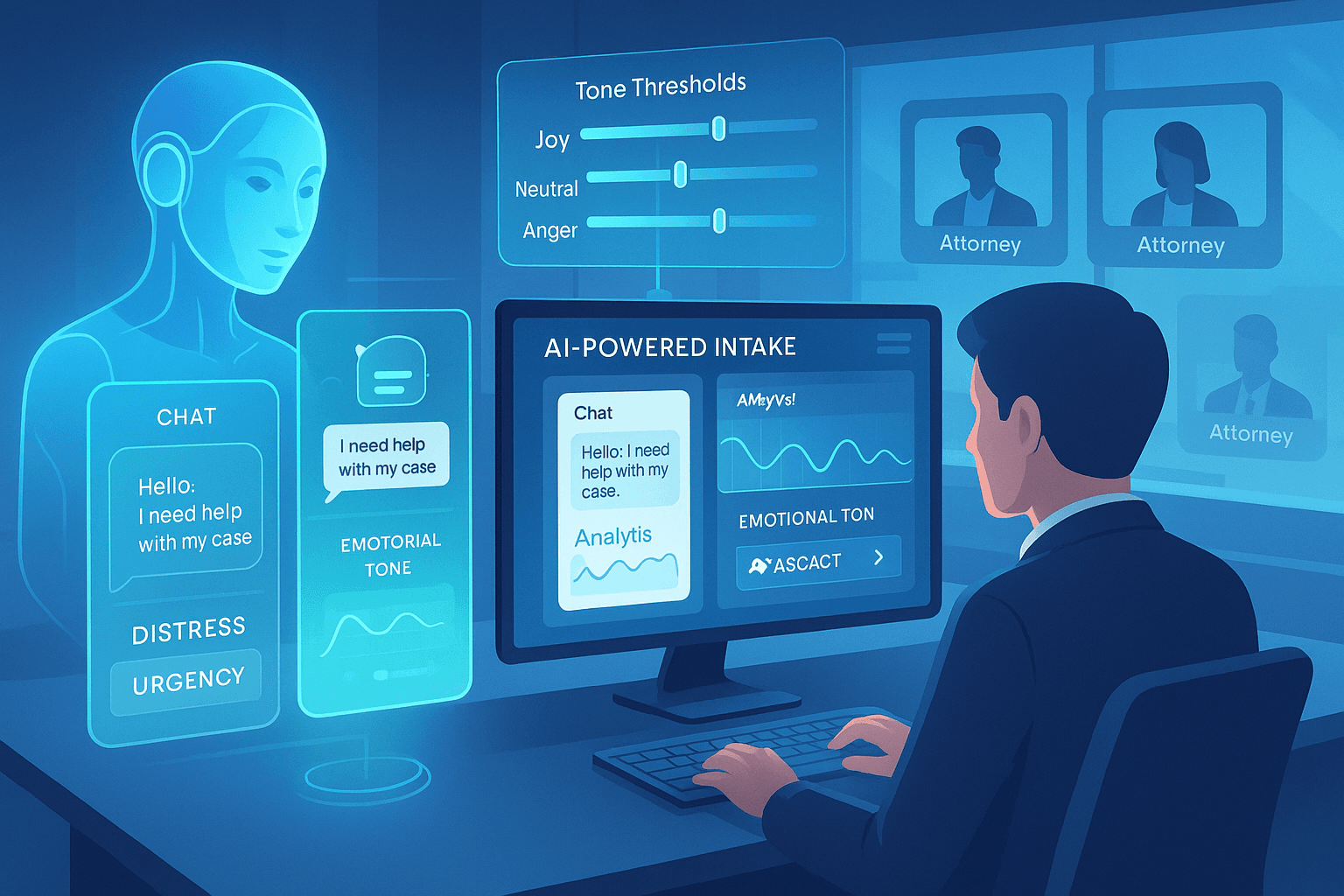
AI tone sensitivity legal intake refers to the use of artificial intelligence to detect, interpret, and respond to the emotional tone of clients during the intake process. This technology enables empathetic, professional, and responsive communication. Increasingly, attorneys rely on AI to pick up subtle cues such as urgency, distress, or even frustration in a client’s voice or messages. Setting legal AI tone thresholds ensures clients feel genuinely understood and cared for, while escalation detection settings legal AI safeguard against missed signals.
Ensuring client interactions are handled with empathy and promptness is critical for trust and service quality. Modern solutions like tone-aware intake automation attorneys and client emotion trigger chatbot law are making a significant impact on intake responsiveness and outcomes.12
Customizable escalation parameters are no longer optional. They drive accurate, context-sensitive escalations using escalation detection settings legal AI, making sure every critical client is routed to an attorney promptly.
Understanding AI Tone Sensitivity in Legal Intake
AI Tone Sensitivity Legal Intake: Decoding Emotional Intelligence with AI
AI tone sensitivity legal intake in law involves sophisticated technology designed to read between the lines. Instead of looking at only literal message content, these systems analyze a client’s underlying emotional state—whether that’s stress, satisfaction, anger, or confusion—using signals embedded in their word choice, phrasing, and syntax.
Key Features of Tone Sensitivity in Legal AI Intake:
Emotion and Intent Detection: AI doesn't just parse sentences for legal facts; it extracts cues indicating the mood or psychological state of a client using advanced language models. Learn more about AI for lawyers
Escalation Detection Settings Legal AI: These settings instruct the system when an emotional trigger, such as distress or urgency, warrants immediate attention from a human attorney. See escalation detection details
Common Challenges
Misinterpretation of Subtle Cues: Clients may use polite or coded language to express distress. AI models must catch these subtleties without overreacting.
False Positives & Negatives: Sometimes, ambiguous language leads to false alerts. Culture-dependent idioms or humor can confuse algorithms.
Lack of Context: A standalone phrase might signal urgency in one context but not in another. Without historical or situational context, accuracy drops.
Natural language processing (NLP) and machine learning power these systems to learn from vast amounts of client data. They correlate linguistic features and conversational patterns with emotional states, setting alerts or escalating complex cases as needed.
By tuning AI tone sensitivity legal intake and calibrating escalation detection settings legal AI, firms prevent critical clients from slipping through the cracks while avoiding unnecessary hand-offs.
Learn More:
Importance of Customizable Tone Detection Sensitivity
Escalation Detection Settings Legal AI: Why One Size Does Not Fit All
Legal practices vary—not just in terms of size but the types of clients they serve. For escalation detection settings legal AI to add measurable value, customization is key.
The Diversity Factor
Practice Area Sensitivity: Family law clients describe distress differently than corporate or criminal law clients.
Demographic Impact: Age, culture, and preferred communication style all influence how emotions are expressed.
Volume and Complexity: High-volume personal injury firms need distinct detection settings from boutique intellectual property practices.
Adjustable Legal AI Tone Thresholds: How They Help
Minimize False Negatives
Alert attorneys to genuine emergencies that less-sensitive settings would miss.
Prevents “silent suffering” scenarios where a client’s quiet distress goes undetected.
Reduce False Positives
Avoid overwhelming attorneys with unnecessary case escalations.
Ensures that urgent interventions are reserved for truly critical cases.
Enhance Response Accuracy
Increased reliability and trust in the automation process.
Law firms can tailor responses to their unique demographic and caseload.
Benefits Recap
Timely Escalation to Attorneys: At-risk clients are promptly flagged for personal outreach.
Empathetic, Personalized Communication: Each inquiry receives responses that match its emotional context.
Competitive Differentiation: Firms with tuned AI tone sensitivity deliver superlative client experiences.
Further Reading:
Client Emotion Trigger Chatbot Law Applications
Client Emotion Trigger Chatbot Law: Automation for Empathetic Alerts
A client emotion trigger chatbot law is an AI-powered system specifically programmed to watch for emotional red flags—stress, urgency, fear, or repeated frustration—during the intake process.
How Do Emotion Triggers Work in Legal Chatbots?
The AI actively listens for certain keywords or patterns:
Distress Words: “Afraid,” “unsafe,” “help now,” “urgent.”
Escalation Phrases: “No one’s called me back,” “I can’t wait any longer,” “emergency situation.”
Frustration Patterns: Repeated submissions, escalating complaints, or indications that prior outreach wasn’t effective.
Real-World Example Scenarios
Eviction Panic: If a client expresses panic about facing eviction, mentioning feeling “unsafe at home” or needing help “as soon as possible,” the chatbot flags the matter for a same-day attorney review.
Frustration Loop: A client submits several unresolved requests in quick succession. The system recognizes this pattern as growing frustration, prompting proactive human follow-up.
Proactive vs. Reactive Communication
A major advantage of tone-aware intake automation attorneys is the balance between direct escalation and proactive support. This means sensitive matters are resolved—sometimes automatically—before escalation is even needed.
In Summary:
Promotes safety and well-being through immediate escalation for high-risk words/behaviors.
Builds trust via fast, sensitive replies tailored to the client’s actual emotional state.
More Details:
Setting Up Legal AI Tone Thresholds
Legal AI Tone Thresholds: Step-by-Step Customization for Maximum Impact
Configuring legal AI tone thresholds properly is essential for productive, sensitive, and efficient client intake.
Step 1: Map Typical Client Communication Patterns
Collect intake transcripts, emails, chats: Identify common language, emotional queues, and urgent triggers.
Determine typical emotional intensity: Classify phrases and word choices from calm to crisis levels.
Step 2: Categorize Escalation Sensitivity
Establish Levels:
Low: Standard inquiries, legal questions.
Medium: Frustration, confusion, moderate urgency.
High: Panic, anger, risk, threats of harm.
Tailor for Demographics and Practice Area: Adjust for culture, age, or historically sensitive topics (family law, criminal defense, etc.).
Step 3: Calibrate Regularly
Monitor caseload evolution: As your firm grows or changes focus, recalibrate your thresholds.
Use attorney feedback: After handling flagged cases, collect attorney opinions on AI accuracy.
Step 4: Test, Audit, and Refine
Simulated Interactions: Run sample scenarios to stress-test the model.
Client Feedback: Ask intake clients about their perception of the intake’s empathy and understanding.
Iterative Refinement: Continually balance helpfulness against unnecessary escalation. Learn about automated legal workflows
Best Practices Checklist
Combine quantitative data (frequency of urgent flags) with qualitative attorney/client feedback.
Schedule regular quarterly reviews for threshold adjustments.
Document all change rationales for consistent future review.
Explore More:
Benefits of Tone-Aware Intake Automation for Attorneys
Tone-Aware Intake Automation Attorneys: Transforming Law Firm Productivity and Client Care
Tone-aware intake automation attorneys leverage AI to automate routine intake, without sacrificing the empathy clients expect from legal professionals.
Main Benefits to Attorneys and Firms
Prioritize High-Urgency Cases: AI flags clients requiring immediate intervention, allowing attorneys to triage effectively and spend time where their expertise is needed most.
Reduce Administrative Burden: AI systems automatically organize, screen, and preliminarily respond to intake inquiries, letting attorneys focus on substantive law.
Consistent, Empathetic Messaging: Responses maintain a caring, professional tone even outside normal business hours or during high-volume periods.
Enhanced Client Outcomes
No Client Overlooked: Emotional distress or urgency is never missed thanks to sophisticated escalation algorithms.
Stronger Attorney-Client Relationships: Clients feel that their needs, concerns, and emotions are genuinely valued, leading to higher levels of satisfaction and loyalty.
Business Case
Heightens client satisfaction metrics, resulting in better reputation and more referrals.
Enhances internal efficiency—fewer dropped cases and less attorney stress.
Additional Benefits List
Automated documentation and compliance support
Integrated analytics for ongoing improvement
Free up valuable attorney time for complex legal analysis or client meetings
Best Resources:
Conclusion: Leading the Future with Customizable AI Tone Sensitivity Legal Intake
The era of rigid, impersonal legal intake is over. Customizable AI tone sensitivity legal intake tools are now essential, not optional, for modern law firms seeking to build trust, assure promptness, and foster truly empathetic client relationships.
Flexible escalation detection settings legal AI are the backbone of smarter, more personalized communication. These tools don’t just enhance response time—they ensure that every client is met with the right balance of professionalism and compassion, right from the first interaction.
The integration of tone-aware intake automation attorneys and client emotion trigger chatbot law solutions is empowering law practices to transform client experience in ways never before possible. By deploying precise legal AI tone thresholds, your firm will excel at identifying client distress, escalating critical matters, and maintaining consistently high standards in every single interaction.
It’s time for law firms to embrace this transformation.
Ready to see how customizable AI tone sensitivity legal intake can elevate your practice? Book a demo of LawHustle today and experience the difference firsthand: https://golawhustle.com/demo
References
For law firms aiming to provide responsive, intelligent, and compassionate service, the future of legal intake is here. Start unlocking its benefits today with LawHustle.
FAQ
What is AI tone sensitivity legal intake?
AI tone sensitivity legal intake uses artificial intelligence to detect and interpret the emotional tone of clients during the legal intake process, enabling firms to respond empathetically and professionally to client needs.
How do customizable escalation detection settings benefit law firms?
Customizable escalation settings allow firms to tailor sensitivity thresholds to their specific clientele and practice areas, minimizing false alerts while ensuring urgent matters receive immediate attorney attention.
What are client emotion trigger chatbots?
Client emotion trigger chatbots are AI-powered tools designed to monitor client inputs for emotional red flags like distress or frustration, flagging critical cases for prompt attorney follow-up or even initiating proactive support automatically.
Why is regular calibration of legal AI tone thresholds important?
Regular calibration ensures that AI models stay accurate and relevant as client behaviors, demographics, and firm focus evolve, maintaining effectiveness in identifying genuine client needs.
How do tone-aware intake automation attorneys improve client care?
They automate routine communication with empathy and consistency, prioritize urgent cases, reduce administrative burdens on attorneys, and foster stronger attorney-client relationships through attentive, personalized engagement.