Written by : Chris Lyle
Nov 21, 2025

Estimated reading time: 18 minutes
Key Takeaways
Google Antigravity revolutionizes software development by using autonomous AI agents working in parallel.
Agent Manager allows developers to orchestrate multiple AI agents to handle complex tasks simultaneously.
The artifact system solves the AI trust gap by providing verifiable proof of AI-generated changes.
Gemini 3 Pro powers Antigravity with advanced reasoning, multi-step task handling, and browser automation capabilities.
Antigravity offers multi-agent collaboration, real-time testing, and planning modes, transforming traditional coding workflows.
The platform is free and publicly available, democratizing AI-powered software development across skill levels.
Table of Contents
Google Antigravity – The Biggest News in AI This Week
What is Google Antigravity?
A Familiar Face, a Radical Core: The Architecture of Antigravity
What Makes Antigravity Special? Core Components and Standout Features
Powered by Gemini 3 Pro: The Brain Behind Antigravity
Traditional Coding vs. Agentic Development: The Ultimate Shift
Advanced Capabilities: Beyond Text, Beyond Boundaries
Getting Your Hands on Antigravity: Free and Open to All
Antigravity’s Ripple Effect: Why This Changes Everything
How Will Antigravity Change the Daily Life of Developers?
The Broader Impact: Accessibility, Learning, and the AI Frontier
Is Antigravity the Final Step? What’s Next for AI Development
Conclusion: The Antigravity Era Has Lifted Off
Explore the Future Today
Google Antigravity – The Biggest News in AI This Week
This week, the world of artificial intelligence was shaken by perhaps its most thrilling announcement yet: the release of Google Antigravity, Google’s revolutionary AI-powered IDE that aims to completely transform how software is built. Gone are the days when software development meant typing out lines of code, poring over bugs alone, or waiting for sluggish AI chatbots to finish their suggestions. With Antigravity, Google launches us into a new era of agent-driven software engineering—and it’s changing everything! Learn more about AI agents
In this deep-dive, we’ll explore what makes Google Antigravity the most exciting development in AI you’ll hear about this week. We’ll look closely at its innovative architecture, its powerful AI core (Gemini 3 Pro), and its implications for everyone who writes code—from curious hobbyists to the world’s most skilled developers. Strap in: the future of coding is here, and it’s out of this world.
What is Google Antigravity?
On November 2025, Google dropped an AI bombshell: Antigravity, a brand-new, next-generation integrated development environment (IDE) supercharged by artificial intelligence, was released to the public for free (official video source). Built for both professionals and weekend tinkerers, Antigravity doesn’t just help you code—it actively becomes your software development partner.
What makes it special? Antigravity is the world’s first truly “agentic” development environment. Instead of one AI assistant waiting on your every command, teams of autonomous agents work alongside you, tackling tasks in parallel, presenting concrete proof of their work, and even “talking” to one another to collaborate on complex challenges (see Codelabs quickstart). You can learn more about how AI agents differ from traditional automation in this detailed blog.
No other IDE—from JetBrains to GitHub Copilot—can do what Antigravity does. Instead of you writing every function or inspecting every line for errors, you tell Antigravity what needs to be done. Its AI-powered agents brainstorm, plan, code, test, and validate, multiplying a single developer’s output to unprecedented levels.
A Familiar Face, a Radical Core: The Architecture of Antigravity
Let’s go under the hood.
Google Antigravity is built on a solid, user-friendly foundation: Visual Studio Code (VS Code) (overview video). This means that, right from the start, developers get a familiar interface with all the bells and whistles they’re used to. But under the surface, everything changes.
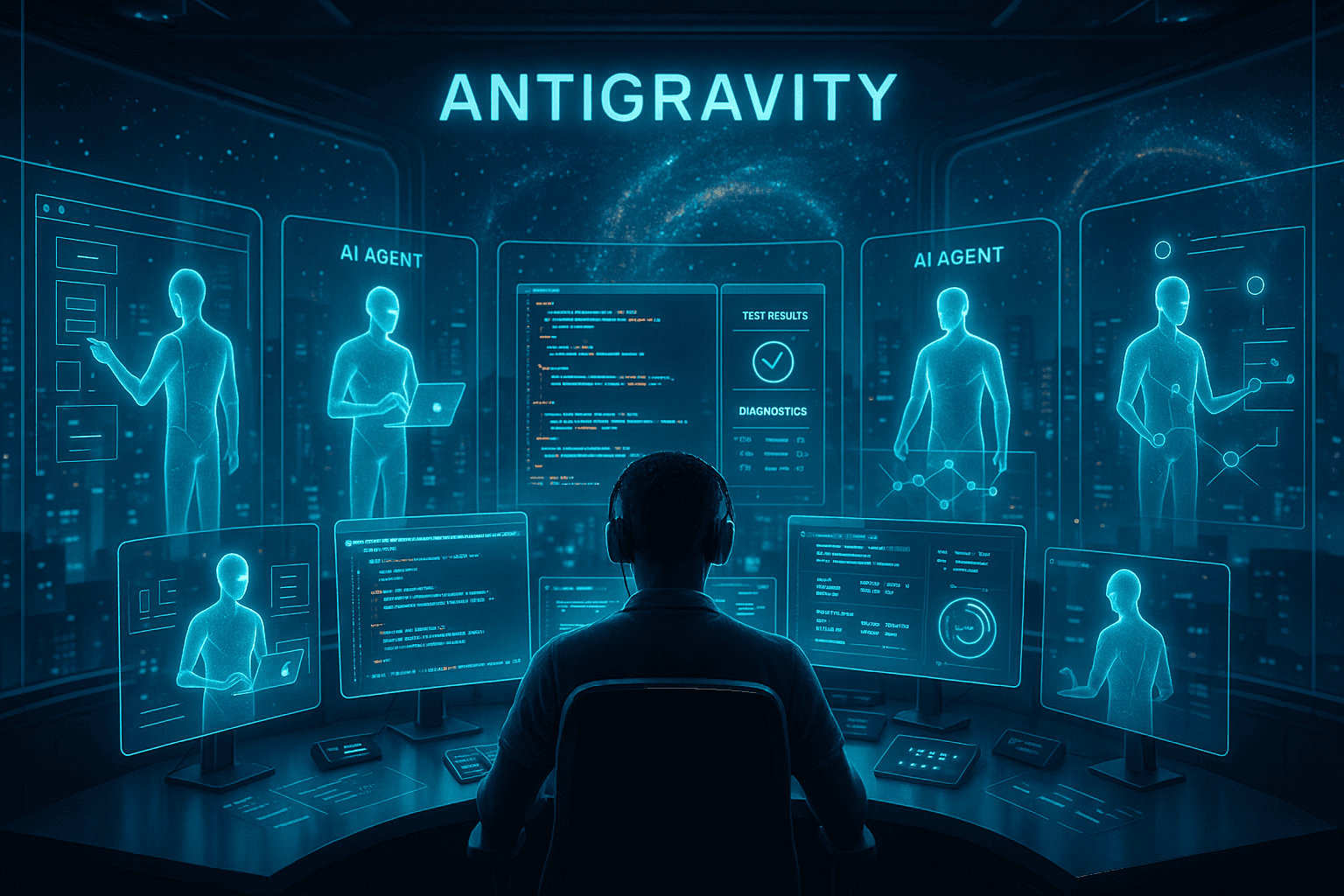
Instead of a chatbot that waits for you to type (and then returns a single answer), Antigravity is agent-first (Codelabs resource). Here’s the game-changer: imagine five different parts of your app have five separate glitches. With Antigravity, you can send five agents to fix those bugs all at once—no waiting, no bottlenecks. In its “Manager View,” you direct and watch autonomous agents as they complete complex jobs in parallel. It’s like running a mission control center for your own AI-powered development team (learn more in Codelabs). Learn how production-ready AI agents maintain state and memory in this blog post.
This approach solves a huge pain point of past AI helpers: you no longer need to wait for one slow reply at a time. You’re running a software factory, orchestrating an army of high-speed, reliable, and self-validating bots.
What Makes Antigravity Special? Core Components and Standout Features
1. Agent Manager: Your AI Mission Control
At the heart of Antigravity is the Agent Manager. Here, you can create, direct, and watch multiple AI agents as they work together throughout your development environment (cension.ai blog). You might send one agent to fix a broken login, while another refactors your CSS, and a third investigates why your tests are failing.
You can track what each agent is working on, reassign jobs, and review detailed logs of their decisions, just like a project manager handles a team of engineers.
2. Artifacts – Solving the AI “Trust Gap” for Good
Trust is everything when working with AI. In earlier tools, if an AI said it fixed a bug, you just had to hope it was right.
Antigravity completely solves the “trust gap” with its artifact system (Codelabs explanation). Every agent must provide proof: when it says a bug is fixed, it generates concrete artifacts. These might include:
Task plans: “Here are the steps I’ll take.”
Implementation plans: “Here’s my code and why I changed it.”
Walkthrough plans: “This is how you can verify my fix, step by step.”
Because of these artifacts, developers can see, question, and verify each change before accepting it. You’re no longer at the mercy of AI “black boxes.” You have audit trails for every move an agent makes—making Antigravity not only smart, but far more trustworthy (read more).
3. Testing, Browsing, and Self-Validation Built In
Want lightning-fast feedback when your changes break something? Antigravity has a built-in browser for real-time testing and verification (demo video). As agents build and edit your app, they can also “drive” the builtin browser, launching, clicking, and even visually inspecting UI elements using browser automation.
That’s possible thanks to Gemini 2.5 Computer Use, which lets agents use and control browsers just like a real user would (official blog). Agents check their own work by actually running and visually checking the code they just wrote or fixed.
4. Multi-Agent Collaboration: AI Teamwork
Antigravity’s agents don’t work in isolation. One might generate new backend code, another might update your unit tests, and a third could start reviewing the same code right away. This teamwork makes the whole software cycle radically faster than ever possible with just one developer (Codecademy guide). See practical tips for building and orchestrating your own agents: practical guide blog
5. Planning Mode: Blueprinting Before Coding
Before a single line of code is written, Antigravity’s planning mode takes over. The platform first analyzes your project, mapping dependencies and challenges, then creates a step-by-step implementation plan (see video overview). You get complete transparency: agents reveal exactly how they’ll tackle your goals and who will do what, all before writing code (video).
Powered by Gemini 3 Pro: The Brain Behind Antigravity
The magic behind Antigravity’s superpowers is Gemini 3 Pro, Google’s latest, most advanced foundation model (Google official blog). Here’s why that matters:
Gemini 3 Pro excels at multi-step tasks: planning, reasoning, adapting, and executing (analysis article). Explore how autonomous planning tools like AutoGPT are reshaping AI workflows: AutoGPT game changer blog
It achieves record-breaking reliability and accuracy on tough software benchmarks, including:
Antigravity also uses Gemini 2.5 Computer Use for browser tasks and Nano Banana (Gemini 2.5 Image) for image editing (official blog)—giving you one unified toolkit for everything from writing code to manipulating graphics in your app.
Traditional Coding vs. Agentic Development: The Ultimate Shift
With Antigravity, the “how” of development has been flipped on its head. Take a look:
Aspect | Traditional Development | Antigravity’s Agentic Development |
|---|---|---|
Code Writing | Manual, file-by-file editing | Assigned to parallel, autonomous agents |
Debugging | Manual breakpoints & troubleshooting | Automated browser-based debugging |
Environment Switching | Tedious editor-browser hopping | Auto-orchestrated, simultaneous changes |
Testing | Sequential manual testing | Continuous, AI-driven verification |
Instead of you shuffling files, flipping from editor to browser to test, and single-stepping through every issue, Antigravity lets you describe the “what” and let your agents handle the “how.” You’re the architect, AI is the engineer (Codecademy explanation).
Advanced Capabilities: Beyond Text, Beyond Boundaries
1. Visual Layouts and Dynamic App Views
Not only does Antigravity output code—it creates scrollable, beautiful, interactive user interfaces, like vivid magazine pages or structured tables (feature blog). The platform’s Dynamic View feature builds custom apps, interactive visualizations, and simulations instantly. You get more than code: you get clickable, see-it-to-believe-it previews.
2. Orchestration Across Every Workspace
Its agents nimbly jump from the code editor to the terminal to the browser, shifting between tools and acting on files, terminals, or web views without missing a beat (official video). It’s a symphony of automation that takes even the most complex development tasks and makes them smooth, streamlined, and—dare we say—fun.
3. Real-Time End-to-End Implementation
From your idea to a working app, Antigravity can build entire projects from natural language instructions (learn how at Codecademy). Tell it, “Build a to-do web app with user login and reminders.” The agents plan, generate code, test, bug-fix, and even verify your finished product—all without you writing (or even seeing) a single line unless you want to.
Getting Your Hands on Antigravity: Free and Open to All
The best part? Google Antigravity is 100% free in public preview as of November 2025 (launch announcement, Codecademy guide). For the first time, hobbyists and enterprise-grade developers alike can use the same agentic development workflow.
Just visit the official Antigravity portal to sign up and get started—it’s designed to onboard you in minutes, with easy install instructions and instant access to Gemini 3 Pro (visit the portal).
Antigravity’s Ripple Effect: Why This Changes Everything
Why does Antigravity stand out amid all the “AI for software” noise?
Until now, AI has been a sidekick: something you “ask” for hints, a fancier autocomplete, a chatbot that struggles with big-picture planning. Antigravity is a radical leap: AI moves from tool to teammate.
You don’t “prompt” agents line-by-line. You assign whole missions.
You don’t “guess” if the AI’s right. Antigravity shows its work with plans, artifacts, and live test results.
You’re not limited to one thing at a time. Five, ten, or even dozens of agents can work for you, all at once.
As Google’s Gemini team writes: “Rather than using AI as a tool in their toolkit—like autocomplete or suggestions—the platform positions AI agents as active development partners that can autonomously plan and execute complex, end-to-end software tasks while validating their own work.”
That’s not incremental. That’s revolutionary.
How Will Antigravity Change the Daily Life of Developers?
New workflows, new possibilities. Here’s what it might look like…
Scenario 1: Fixing Bugs at Warp Speed
Previously, you found a bug, analyzed the code, wrote a fix, tested it, and repeated—all by hand, all by yourself. With Antigravity, you drop your bug list in the Agent Manager. Each agent grabs a bug, creates a plan, demonstrates the fix, and delivers not just the code, but a record of what it did and how it knows it’s fixed.
Scenario 2: Building Features in Parallel
Ask for a new feature—say, a “dark mode toggle” and an “export to CSV” tool. Instead of choosing which to tackle first, you assign both to agents at once. They coordinate, avoid clashing over the same code, and test their work automatically. You’re not one developer; you’re a whole agile team.
Scenario 3: Rapid Prototyping and Experimentation
Dream up a wild idea. Type it in plain English. The planning mode plots a blueprint; agents code, run, and verify a prototype app before your eyes—sometimes in minutes.
The Broader Impact: Accessibility, Learning, and the AI Frontier
Opening the Door for Everyone
By making Gemini 3 Pro free and accessible, Antigravity democratizes AI-powered development. Beginners can learn by watching agent workflows and reviewing artifacts. Pros can hand off repetitious tasks and focus on big-picture system design.
Workflows for the Next Generation
No more wrestling with configuration, context-switching, or mindless repetition. The IDE does the boring work, letting humans stay creative and strategic.
End-to-End Verification and Reliability
Because agents test and validate their own output, the days of “it compiles, ship it!” are over. Teams can trust that what goes live has been through an automated gantlet of analysis, planning, testing, and reporting. The result? More reliable apps, less late-night bug hunting.
Pushing the AI Envelope
With dynamic visual layouts, simultaneous cross-workspace coordination, and image manipulation built in, Antigravity is more than coding help—it’s a unified AI-powered engineering suite.
Is Antigravity the Final Step? What’s Next for AI Development
With Antigravity, software creation is unrecognizable from even a year ago. The agentic revolution opens new doors for AI, human-computer interaction, and what’s possible with code.
Will the programmers of tomorrow be architects and strategists, managing swarms of AI-powered coders?
Will this make software creation accessible to everyone, not just those with years of training?
Can agentic AI build, secure, test, and validate code safer and faster than human-only teams?
If the trajectory holds, the answer is a resounding yes—and the implications for business, education, entertainment, and beyond are only beginning to be explored.
Conclusion: The Antigravity Era Has Lifted Off
It’s rare to witness a true leap in how technology is made. This week, with the launch of Google Antigravity, we’ve seen just that. From a familiar coding interface hiding an agentic powerhouse, to a layered system of planning, validation, parallel collaboration, and real-time testing, Antigravity represents a bold vision for the future of software development.
Built on the mighty Gemini 3 Pro foundation, supercharged with multi-agent orchestration, designed with trust (artifacts) and real-time testing at its core, and accessible—for free—to anyone, Google Antigravity unlocks a universe of invention for all.
The only question left: What will you build with it?
Explore the Future Today
Stay tuned to our blog for more on the world’s biggest AI news—and happy coding in the Antigravity age!
FAQ
What is Google Antigravity?
Google Antigravity is an AI-powered integrated development environment (IDE) designed to transform software development by enabling autonomous AI agents to work collaboratively and in parallel, automating coding, testing, debugging, and planning tasks.
How do the AI agents in Antigravity collaborate?
Agents in Antigravity operate autonomously but communicate with each other, handling different tasks simultaneously. One agent might write code, another tests it, and another reviews it, creating a multi-agent teamwork environment orchestrated through the Agent Manager.
Is Google Antigravity free to use?
Yes, Google Antigravity is available for free in public preview as of November 2025, allowing anyone—from hobbyists to professionals—to access its AI-powered software development features.
What is the role of Gemini 3 Pro?
Gemini 3 Pro is the advanced AI foundation model powering Antigravity, enabling multi-step reasoning, planning, execution, and browser automation which allows agents to perform complex tasks efficiently and accurately.
How do artifacts improve trust in AI within Antigravity?
Artifacts provide detailed, verifiable proof of AI-generated changes, like task plans and walkthroughs, allowing developers to review and audit each step, thus bridging the trust gap common in earlier AI-assisted development tools.