
Written by : Chris Lyle
Nov 28, 2025

Estimated reading time: 18 minutes
Key Takeaways
AI agents are evolving from simple responders to autonomous helpers capable of reasoning, planning, and collaborating.
The Illustrated Guide to AI Agents uses vivid visuals and stories to simplify complex AI concepts for all audiences.
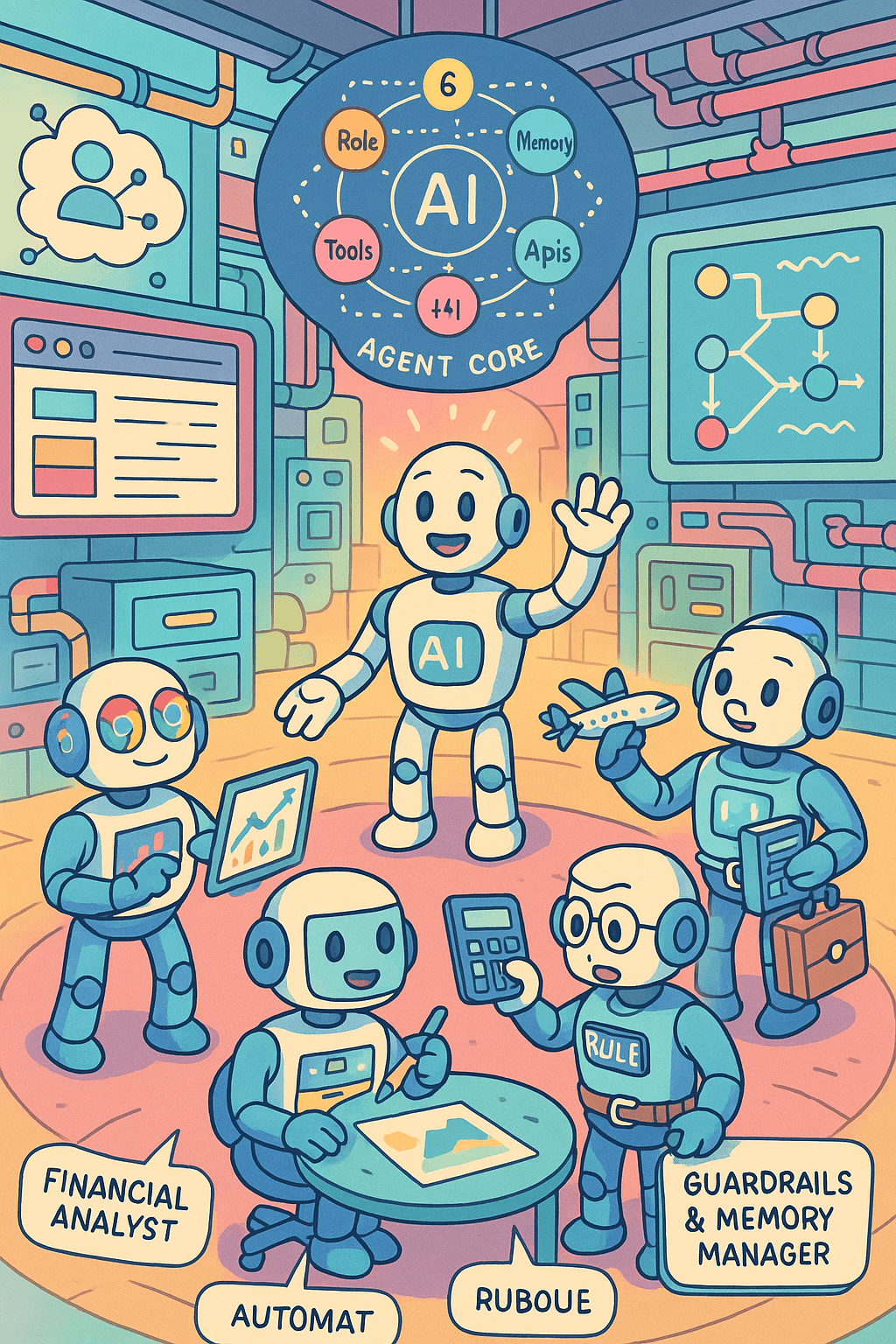
Six foundational building blocks—role-playing, focus/tasks, tools, cooperation, guardrails, and memory—constitute effective AI agents.
Design patterns like reflection, tool use, planning, and multi-agent collaboration enable diverse AI agent capabilities.
AI agents differ from LLMs and RAG by combining reasoning, tool use, memory, and teamwork to act autonomously.
Multi-agent frameworks orchestrate specialized agents for complex problem solving and enhanced productivity.
Table of Contents
Introduction: Welcome to the AI Agent Adventure
Let’s Start With the Basics: What Are AI Agents?
The Core Purpose: Why This Guide Makes a Difference
Unpacking the Key Topics: What’s Inside the Illustrated Guide?
The Six Building Blocks of Every AI Agent
Five Powerful Patterns for Building AI Agents
From Novice to Expert: The Five Levels of Autonomous AI Agents
Real-World Magic: The Projects Bringing AI Agents to Life
Clearing Up Confusion: AI Agents vs LLMs vs RAG
Peeking Under the Hood: How Are AI Agents Built?
When Many Agents Join Forces: Multi-Agent Frameworks
The Power of Pictures: Why Visual Learning Works
How AI Agents Are Shaping the Future
The Illustrated Guide in Action: A Walkthrough Example
Beyond the Buzz: Why Every Organization Should Understand AI Agents
The Frontiers: What’s Next for AI Agents?
Where to Learn More & Final Thoughts
Wrap-Up: You’re Part of the Story
FAQ
Introduction: Welcome to the AI Agent Adventure
This week in the world of artificial intelligence, a new educational resource is making headlines:
“An Illustrated Guide to AI Agents.” If you’re curious about what AI agents are https://golawhustle.com/blogs/what-is-an-ai-agent, how they work, and why everyone from tech professionals to students is buzzing with excitement, you’re in the right place. This illustrated guide, written by Maarten Grootendorst and Jay Alammar and published by O'Reilly, promises to make the mysterious realm of AI agents simple, colorful, and fascinating for everyone—no matter your age or background (O'Reilly Guide).
But what are AI agents, really? Why are they causing such a stir? And how can an illustrated guide help you unlock big ideas with easy-to-understand pictures and stories? Get ready for a colorful adventure as we explore all these questions and more, taking you through the building blocks, patterns, levels, and real-world magic of AI agents.
Let’s Start With the Basics: What Are AI Agents?
If you’ve ever talked to Siri, asked ChatGPT a question, or used a voice assistant, you’ve met simple artificial intelligence before. But today’s AI agents have moved beyond just answering questions. They can think, plan, work together, and even make decisions all on their own. This leap from “simple responders” to “smart helpers” is what’s changing our world, from helping write stories to managing brand reputations or even planning vacations (O'Reilly Guide).
“An Illustrated Guide to AI Agents” does something special: it uses vivid pictures and real-life stories to make these amazing tools easy to understand. Whether you’re a professional, a student, or just a curious explorer, this guide is made for you.
The Core Purpose: Why This Guide Makes a Difference
With artificial intelligence making headlines every day, it’s easy to get lost in the buzzwords—LLMs, RAGs, autonomous agents, and more. The Illustrated Guide to AI Agents (2025 Edition) cuts through the confusion. It bridges the gap between confusing theory and real-life usefulness, showing you what really happens inside AI agents and, more importantly, how you can use this knowledge for practical stuff in your job, your school work, or your creative projects (O'Reilly Guide).
This guide isn’t just about reading—it’s about seeing and doing. Hundreds of easy-to-follow graphics make complex concepts like “agentic reasoning” as simple as a comic strip. And with real-world examples sprinkled throughout, it’s never boring.
Unpacking the Key Topics: What’s Inside the Illustrated Guide?
Let’s peek inside the guidebook and see what treasures it holds! Here are the key topics the guide dives into (O'Reilly Guide):
Core Architecture: What parts do all AI agents need to function? Tools, memory, and planning are at the heart of every agent.
Advanced Models: You’ll discover the latest in LLMs (large language models) that can reason, see and hear (multimodal models), and even cooperate with each other in multi-agent systems.
Optimization Techniques: Learn how experts make AI agents faster and smarter using tricks like distillation, quantization, and teaching them with rewards (reinforcement learning).
Practical Evaluation: Find out how we can test AI agents in the real world—seeing where they shine and where they still need to grow.
By combining these big ideas, you’ll get a full picture of the wonderful, puzzling, and powerful world of AI agents.
The Six Building Blocks of Every AI Agent
So, what makes an AI agent tick? The Illustrated Guide explains that every strong agent is built from six main building blocks https://golawhustle.com/blogs/a-practical-guide-to-building-agents:
Role-Playing: Give your AI agent a clear job or persona—like a helpful librarian or an expert tour guide—and its performance skyrockets.
Focus/Tasks: Agents need to know what they’re supposed to do. Clear goals mean clear actions.
Tools: These are the gadgets and powers your agent can use to solve problems—anything from searching the web to controlling a robot, or using special Model Context Protocol (MCP) tools.
Cooperation: Sometimes, one agent isn’t enough. Agents can work together as a super-team, with one handling research, another writing summaries, and another checking for errors.
Guardrails: Just like bumpers in a bowling alley, guardrails set safety rules and limits so agents stay on track and don’t color outside the lines.
Memory: Agents need to remember what’s happened before—either in the same conversation or across many days—to get better at their jobs.
These six blocks are the ingredients for any successful AI agent recipe. Mix them right, and you get a system that’s smart, helpful, and safe.
Five Powerful Patterns for Building AI Agents
How do you actually build AI agents in the real world? The guide introduces five design patterns that experts use to give agents smarts, flexibility, and power https://golawhustle.com/blogs/autogpt-game-changer-autonomous-ai:
Reflection Pattern:
The agent learns to reflect, review, and correct its own answers—just like a student checking their homework before turning it in.Tool Use Pattern:
Turn your agent into a handyman—able to reach for the right tool at the right time, from calculators to web browsers.ReAct (Reason & Act) Pattern:
Here, the agent reasons about a problem, decides on the next step, and acts—step by logical step—until it solves the task.Planning Pattern:
For complicated missions, this pattern helps the agent map out a plan, break it into manageable steps, and tackle each piece in order.Multi-Agent Pattern:
Imagine a team: A “manager” agent delegates tasks to the right specialists, like a general with a squad of experts all working together.
With these patterns, AI agents don’t just react—they plan, organize, self-correct, and collaborate. Suddenly, they’re not just helpers; they’re smart workers and teammates.
From Novice to Expert: The Five Levels of Autonomous AI Agents
Not all AI agents are created equal. They range from simple responders to advanced, independent decision-makers. The illustrated guide breaks this journey into five clear stages https://golawhustle.com/blogs/ai-agents-for-beginners-guide:
Basic Responder: The simplest type—answers questions, but that’s about it.
Router Pattern: More clever—it decides which “mini-expert” should answer which question, routing tasks to the right place.
Tool Calling: Now, the agent can pick up real tools—searching the internet, running code, or sending emails when needed.
Multi-Agent Pattern: Here, multiple agents collaborate, each handling their part in a coordinated dance.
Autonomous Pattern: The top of the mountain! The agent can plan, decide, and take initiative—all without constant human instruction.
As agents move up these levels, they take on more responsibility and independence, turning from simple helpers into powerful coworkers and problem-solvers.
Real-World Magic: The Projects Bringing AI Agents to Life
So, what can AI agents actually do for you? The 2025 edition of the Illustrated Guide is bursting with twelve real-world project examples, from business helpers to creative partners (Scribd - Illustrated Guide). Here’s just a taste:
Agentic RAG Systems: These agents combine retrieval (finding info) and generation (creating answers) for powerful Q&A systems.
Voice-Enabled RAG Agents: Use your voice to ask questions and get spoken answers, perfect for hands-free helpers.
Multi-Agent Flight Finder: Agents collaborate to find the best flights across airlines, prices, and schedules.
Financial Analyst Systems: Automated AI agents keep an eye on financial news, track stock trends, and offer smart advice.
Brand Monitoring Systems: Agents scan news and social media to help brands keep their reputation sparkling.
Hotel Finders, Deep Researchers, Content Creators: From booking your next vacation to writing reports and articles, agents handle it all.
Human-Like Memory Implementations: Agents remember your preferences and history, tailoring answers just for you.
Book Writers, Documentation Workflows, News Generators: Creative tasks, technical write-ups—even real-time news coverage—are getting the AI agent boost.
These projects are more than science fiction—they’re happening in businesses, classrooms, and creative studios right now.
Clearing Up Confusion: AI Agents vs LLMs vs RAG
There’s a lot of confusion out there—so let’s break it down! The Illustrated Guide explains the crucial difference between three big ideas (Scribd - Illustrated Guide):
Large Language Models (LLMs): These AI brains, like ChatGPT, are great at answering questions and writing—but usually just react to prompts, not plan ahead.
Retrieval-Augmented Generation (RAG): This technology adds a fast memory—so LLMs can “look up” facts from outside sources and answer with up-to-date info.
AI Agents: The stars of our story! Not only do they answer and look up facts, but they also think, reason, plan, choose the right tools, and even work together to get things done—nearly like teammates.
So, if you want something that not only chats, but acts like a mini assistant, detective, or organizer—you want an AI agent!
Peeking Under the Hood: How Are AI Agents Built?
The technology under the surface of AI agents sounds complicated, but the Illustrated Guide makes it simple https://golawhustle.com/blogs/openai-building-ai-agents-future.
Every AI agent needs three core ingredients:
Model:
This is the smart engine at the center—a large language model (LLM) that can understand language, reason, and make decisions.Tools:
The tools are like superpowers. Your agent can use calculators, databases, search engines, business APIs, or even operate physical devices, depending on the task.Instructions (and Guardrails):
These are the rules and guidelines you give your agent—“always be polite,” “only search safe websites,” or “double-check your math.” Guardrails are safety features so the agent behaves well.
Put them all together, and you have an agent ready to face the world: smart, equipped, and guided!
When Many Agents Join Forces: Multi-Agent Frameworks
Sometimes, one agent just isn’t enough—complex problems need a whole team. The guide explores multi-agent frameworks where a “manager” agent assigns jobs to different “worker” agents, each with their own specialty and tools https://golawhustle.com/blogs/google-agentspace-ai-workspace-productivity.
The two essential pieces to make this work:
Initialization:
Deciding and setting up the specialized agents needed—like builders choosing tools for a construction project.Orchestration:
Making sure everyone talks, shares progress, and coordinates, like an orchestra conductor leading the music.
One cool example from the guide is the CAMEL framework, where agents play roles—like “AI User” and “AI Assistant”—collaborating naturally to solve tricky problems (Maarten Grootendorst Newsletter). This role-playing not only makes the conversation flow smoothly but also helps experts design more useful, friendly agents.
The Power of Pictures: Why Visual Learning Works
Reading about AI can be daunting, with strange words and abstract ideas. That’s why “An Illustrated Guide to AI Agents” uses over 60 custom illustrations to bring every idea to life (Maarten Grootendorst Newsletter).
Whether it’s a comic showing agents in a team huddle, a diagram of how memory works, or a flowchart of agent decision-making, seeing is believing. Plus, the guide is available in Korean, Chinese, Vietnamese, and French, so learners all around the world can join the adventure.
How AI Agents Are Shaping the Future
As we peek into the future, it’s clear that AI agents will be a huge part of our daily lives. Here’s why this guide has techies, teachers, and everyday explorers so excited:
For Businesses: Faster help desks, smarter analysts, creative brand monitors, and tireless researchers.
For Students and Learners: Interactive tutors, memory aids, and research partners.
For Creatives: Co-authors, illustrators, and brainstorming buddies.
For Everyone: Safer, smarter, more responsive technology in every corner of life.
And thanks to resources like “An Illustrated Guide to AI Agents,” anyone can understand how it all fits together.
The Illustrated Guide in Action: A Walkthrough Example
Let’s say you want to build your own mini travel agent. Here’s how it could work, step by colorful step, inspired by the guide’s patterns (Scribd - Illustrated Guide):
Role-Playing:
You assign the agent the role of “Flight Finder.”Focus/Task:
Find the cheapest flight from New York to Paris.Tools:
The agent can access flight search engines and price databases.Cooperation:
You add a weather-checker agent to make sure there are no storms expected.Guardrails:
You make sure the agent only checks trusted airline sites.Memory:
The agent remembers your preferred airlines and travel times.
It uses the Planning Pattern to break the task into:
- Step 1: Gather flight data
- Step 2: Filter by date and time
- Step 3: Check for weather
- Step 4: Present the top three options
And, with multi-agent collaboration, your travel, weather, and deals agents work together to offer not just good, but great options.
Beyond the Buzz: Why Every Organization Should Understand AI Agents
It’s tempting to think of AI agents as just a new tech trend. But their real power is changing the way companies, nonprofits, and even schools operate:
24/7 Support: AI agents never sleep, offering instant help and answers at any time.
Cost Savings: By handling busy-work, AI agents free up humans for more creative, meaningful tasks.
Supercharged Productivity: Projects that once took days can sometimes be done in hours, or even minutes.
New Creativity: Writers, artists, and musicians are discovering new ways to co-create with agent teammates.
Global Accessibility: AI agents can be multilingual and available on every device, helping people everywhere.
And when the concepts are illustrated—step by step, picture by picture—more people can unlock their potential.
The Frontiers: What’s Next for AI Agents?
The field of AI agents is moving fast. As the technology advances, illustrated guides will keep evolving—showing us how agents can:
Go from simple helpers to fully autonomous partners.
Use multi-modal abilities (like seeing, talking, and understanding objects) to interact with the real world.
Work together in “agent teams” to handle complex problems—like running scientific labs, organizing global supply chains, or coordinating smart cities.
Stay safe and ethical, using guardrails and memory to always act responsibly, even as they gain more power.
Resources like “An Illustrated Guide to AI Agents” ensure that as AI gets smarter and more independent, everyone can understand how it works—and how to use it for good.
Where to Learn More & Final Thoughts
If you’re ready to see AI agents in action, or perhaps even design your own, look to “An Illustrated Guide to AI Agents” for a world of visual fun and accessible wisdom (O'Reilly Guide).
And for deeper research, you can explore these essential curated resources:
- O’Reilly Guide to AI Agents – The official illustrated reference: https://www.oreilly.com/library/view/an-illustrated-guide/9798341662681/
- Scribd Overview of the Guide – More details and sample visuals: https://www.scribd.com/document/904059766/An-Illustrated-Guide-to-AI-Agents
- OpenAI Practical Guide – Technical deep-dive for builders: https://cdn.openai.com/business-guides-and-resources/a-practical-guide-to-building-agents.pdf
- Visual Guide to LLM Agents Newsletter – Updates and frameworks: https://newsletter.maartengrootendorst.com/p/a-visual-guide-to-llm-agents
The future is bright, and it’s illustrated!
Wrap-Up: You’re Part of the Story
Thanks for joining us on this illustrated adventure into the world of AI agents. From basic responders to autonomous teammates, from helpful chatbots to powerful business analysts, agents are changing the way we live, learn, and create.
And thanks to resources like “An Illustrated Guide to AI Agents,” everyone can understand these changes, building skills and inspiration for the next wave of innovation. If you’re excited to learn more, try exploring the linked resources above, think about how agents could help you in daily life, and get ready for a world where the smartest teammates might just be artificial—but always at your side.
Stay tuned next week for more thrilling news in the world of AI!
FAQ
What are AI agents?
AI agents are intelligent systems that go beyond basic AI like responding to questions. They can think, plan, use tools, work together, and act autonomously to complete tasks.
How do AI agents differ from LLMs and RAG?
While Large Language Models (LLMs) mainly react to prompts and RAG enhances them with external memory, AI agents combine reasoning, planning, tool use, memory, and teamwork to take autonomous actions and solve complex problems.
What are the key building blocks of AI agents?
The six key building blocks are role-playing, focus/tasks, tools, cooperation, guardrails, and memory. Together, they enable agents to function effectively and safely.
How can multi-agent frameworks benefit AI applications?
Multi-agent frameworks orchestrate specialized agents working together under a manager agent, enabling complex problem solving through collaboration, coordination, and communication.
Where can I learn more about AI agents?
You can explore resources like the O’Reilly Illustrated Guide, the Scribd Overview, and practical guides from OpenAI and Maarten Grootendorst’s newsletter.