Written by : Chris Lyle
Dec 1, 2025

Estimated reading time: 19 minutes
Key Takeaways
Legal incident timeline AI automates the extraction and sequencing of events from complex, unstructured data, enhancing case preparation efficiency.
Smart intake and client statement breakdown AI improve early data capture by structuring raw narratives with context, emotions, and urgency cues.
AI-generated event sequences enable law firms to produce consistent, defendable, and persuasive case chronologies that support litigation strategy and discovery.
Advanced layered technical processes including NLP, semantic analysis, and contextual reasoning underpin AI timeline generation tailored to various legal practice areas.
Quantifiable benefits include significant reductions in case assessment time, document review cycles, and brief preparation, enabling attorneys to focus on strategic work.
Future AI developments in legal timelines target predictive modeling, deeper integration with case management systems, and broader applicability across litigation and compliance.
Table of Contents
Introduction: The Rise of Legal Incident Timeline AI
The Need for AI in Incident Timelines
What is Case Chronology Automation for Law Firms?
The Role of AI-Generated Event Sequences in Legal Workflows
Smart Intake and Event Collection
Client Statement Breakdown Using AI
Technical Overview of AI Timeline Generation for Lawyers
Practical Benefits to Law Firms and Clients
Conclusion and Future Outlook
FAQ
Introduction: The Rise of Legal Incident Timeline AI
Legal incident timeline AI represents a transformative shift in legal technology. This term refers to artificial intelligence systems that automatically analyze client statements, extract relevant events from multi-format data, and construct accurate, sequentially organized chronologies for legal cases (Nexlaw.ai). AI timeline generation for lawyers is now critical as legal firms face an ever-growing volume of unstructured client information and demand for faster, more accurate case preparation. For a broader overview of how AI is reshaping law firm processes, see our comprehensive guide on AI in legal practice
Smart Intake Event Collection
Smart intake event collection is the process where AI captures critical case-related events at the earliest stage—right at client intake. By structurally mining details in real time, AI systems ensure that nothing is missed, even as clients narrate complex or disorganized stories. To learn more about how automated intake streamlines onboarding, check out our post on automated legal intake
Key Practice Areas Benefiting from Legal Incident Timeline AI
Personal injury: Automatically creates a sequential medical and incident narrative, linking treatments, injuries, and recovery milestones.
Learn how AI is transforming personal injury workflows: https://golawhustle.com/blogs/ai-for-personal-injury-law-firmsEmployment law: Clarifies the timeline of harassment, policy breaches, or workplace incidents through structured event mapping.
Discrimination: Identifies patterns by sequencing disparate incidents and highlighting correlation points.
Contract disputes: Tracks communications, agreements, breaches, and negotiations in exact order for airtight case presentation.
AI is redefining case chronology across all these practice areas by optimizing both the quality and efficiency of legal workflows (AnytimeAI).
The Need for AI in Incident Timelines
Challenges of Manual Timeline Creation
Law firms historically spend enormous resources on building incident timelines. Creating legal incident timeline AI solutions becomes necessary due to:
Fragmented data: Client interviews, emails, records, and documents are spread across multiple sources and formats.
Risk-prone processes: Human reviewers can introduce gaps, chronological mistakes, and inconsistencies.
Time wasted: Manual review and assembly divert senior legal talent from core legal strategy.
Negative Consequences of Flawed Timelines
Vulnerability: Gaps or discrepancies can be exploited by opposing counsel during discovery or trial.
Persuasion lost: Judges and juries require seamless, sequential events to grasp a case. Confusing timelines create doubt and undermine client credibility.
Missed connections: Overlooked causality, patterns, or damages due to incomplete event sequencing.
The Imperative for AI-Generated Event Sequence Legal Outputs
AI-generated event sequences are indispensable to:
Clarify causality links in complex cases
Quantify damages over relevant periods
Reveal behavioral or organizational patterns
Construct persuasive, defendable narratives
With mounting caseloads and intricate documentation, legal incident timeline AI is no longer optional—it is the backbone for error-free chronology and strategic legal work.
(Nexlaw.ai)
What is Case Chronology Automation for Law Firms?
Defining Case Chronology Automation for Law Firms
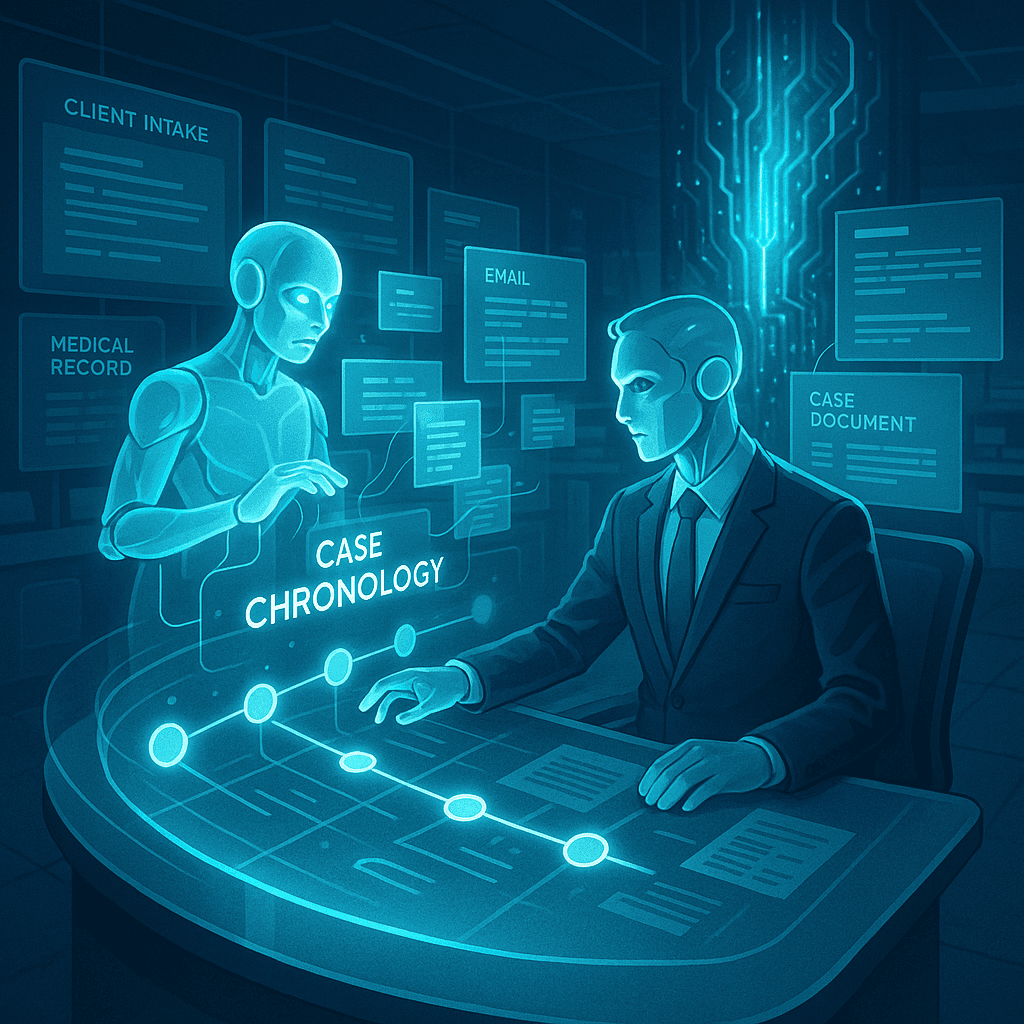
Case chronology automation for law firms is an AI-driven process that extracts, analyzes, and chronologically orders events from all case-related data. Unlike old document management tools, these AI systems utilize:
Natural Language Processing (NLP) to identify temporal, participant, and contextual markers
Semantic analysis to resolve ambiguities and implicit time references
For a step-by-step guide on automating legal workflows, see: https://golawhustle.com/blogs/automated-legal-workflow
How Case Chronology Automation Works
Data ingestion: Pulls from interviews, statements, depositions, records, emails, and external sources.
AI analysis: Applies NLP and context modeling to spot relevant details: dates, times, places, people, actions.
Sequencing and gap detection: Reorders events, correlates implicit and explicit time references, and flags missing periods for attorney review.
Benefits of AI-Driven Chronology Automation
Speed: Reduce what would take weeks to hours.
Error minimization: Systematic extraction shields against omissions, duplication, or misordering.
Early clarity: Delivers client-ready, evidence-backed timelines from the outset.
Complexity management: Resolves non-linear input, enables better client engagement and legal strategy.
For broader insights into streamlining law firm processes, see our post on legal workflow automation
Example Scenario
AI assembles a medical chronology from scattered hospital records, intake statements, and treatment notes—highlighting every procedure, therapy, and consultation in correct order, supporting factual accuracy.
The Role of AI-Generated Event Sequences in Legal Workflows
AI-Generated Event Sequence Legal Outputs
An AI-generated event sequence legal output is a chronological arrangement of all key case events, illuminating patterns otherwise buried in unstructured data. This provides the visual and logical backbone to every kind of legal analysis.
(Nexlaw.ai)
Workflow Transformation
Accelerated comprehension: Attorneys grasp the entire case structure instantly.
Team-wide clarity: Consistent event mapping for every team member, eliminating ambiguity.
Streamlined meetings: Focus shifts from info-gathering to strategy.
Integration with Case Management Systems
Timeline events link directly to underlying evidence, depositions, supporting records.
Clicking any event in the system reveals the attached documentation for quick reference.
Empowered Discovery & Litigation Strategy
Comprehensive timelines guide evidence requests and highlight fact gaps early.
Legal teams can anticipate the opposition’s narrative and prepare rebuttals matching the event order.
Use Case Example
In an employment dispute, AI timeline generation for lawyers clusters incidents around management transitions, revealing patterns suggestive of discrimination or retaliation that might otherwise be missed.
Smart Intake and Event Collection
Smart Intake Event Collection Defined
Smart intake event collection leverages AI to structure case information as clients communicate it—converting raw, unstructured narratives into organized, actionable data from the first point of contact.
How Smart Intake AI Works
Natural input: Clients can speak or write freely, without imposing a strict chronology.
On-the-fly extraction: AI identifies and logs dates, places, participants, actions with contextual awareness.
Emotion and urgency cues: These are captured and tagged for later reference—crucial for personal injury or emotional distress claims.
Real-Time Clarifications
AI-driven prompts request additional details when event descriptions are vague or imprecise.
This increases both quality and completeness at the point of intake, reducing future back-and-forth.
Example
If a client says, “It started last summer,” the system might prompt: “Can you recall if this was before or after the July 4th holiday?”
Enhanced Client Interviews
Clients feel heard and understood—even if they don’t present their story in perfect order.
Administrative friction is eliminated, and input accuracy skyrockets from day one.
Client Statement Breakdown Using AI
How Client Statement Breakdown AI Works
Client statement breakdown AI parses complex, multi-page narratives to systematically extract events, actors, and context—far surpassing human consistency and speed. This is fundamental for legal incident timeline AI and AI-generated event sequence legal output.
Technical Approach
Temporal parsing: Recognizes both explicit (“March 12”) and implicit (“the day after the argument”) event references.
Context segmentation: System scans for contextual cues, linking them to time and participants.
(Clio)
Named Entity Recognition (NER)
AI tags people, organizations, places, and legal concepts throughout the narrative.
Maps and tracks repeated involvement or significant actors across timeline nodes.
Concrete Examples
Spotting significant dates from phrases like, “By mid-February…”
Highlighting missing or ambiguous dates for targeted follow-up by attorneys.
Recognizing recurring individuals in multiple incidents, revealing patterns.
Key Benefits
Extreme speed and accuracy: Full intake breakdown in minutes.
Consistency: No variance due to reviewer experience or fatigue.
Thoroughness: Every event and implied detail receives attention.
(Clio)
Technical Overview of AI Timeline Generation for Lawyers
Layered Technical Process
AI timeline generation for lawyers is underpinned by advanced language and reasoning models. Here’s how the process breaks down, with key elements supporting case chronology automation for law firms and legal incident timeline AI:
1. Linguistic Layer
Parses explicit (“March 15, 2024”), relative (“four days earlier”), seasonal, and event-anchored temporal references.
Maintains a library of temporal expressions.
2. Contextual Reasoning Layer
Infers actual dates when references are ambiguous (“last fall’s meeting”).
Cross-references other documentation, email timestamps, or records when direct dates are missing.
3. Semantic Understanding Layer
Recognizes critical events from indirect descriptions (e.g. “Things escalated after that”).
Understands underlying legal context: escalation, resolution, causality.
4. Case-Type Adaptation Layer
Adjusts event extraction by case area:
Personal injury: prioritizes medical/loss events
Employment: entries for communication, discipline, witness interactions
Discrimination: flags repetitive actor involvement or clustered incident dates
5. Output Formatting Layer
Generates multiple timeline formats:
Visual Gantt charts
Simple event lists
Narrative explanations with embedded links to evidence
Key Benefits
Scalability: Handles vast sets of unstructured data efficiently.
Rapidity: Timelines are generated in hours, not weeks.
Accuracy and Flexibility: Adapts to case specifics and output needs.
For examples of top AI tools in legal workflows, check out our post on revolutionizing legal work
Practical Benefits to Law Firms and Clients
Quantifiable Gains from Legal Incident Timeline AI
85% reduction in case assessment time
70% decrease in document review cycles
60% faster brief preparation
Time Reallocation: Strategic Over Administrative
Attorneys shift focus from mechanical assembly to legal analysis, discovery, and counseling.
Paralegals re-tasked to higher-value verification and narrative refinement.
Superior Accuracy and Consistency
Every event is systematically recorded and mapped.
AI flags events of questionable relevance, ensuring essential incidents aren’t overlooked.
Improved Client Satisfaction
Comprehensive, professional timelines presented from the first meeting.
Enhanced transparency, engagement, and trust.
Reduced need for repeated client questioning.
Positive Impact on Case Outcomes
Early identification of case gaps, actionable patterns, and causality.
Proactive discovery planning and strategic preparation.
Case Study Examples
Personal Injury:
AI sequences every relevant medical event—accident, surgeries, appointments, therapy sessions—tying timelines to documentation. Attorneys can instantly see extended recovery periods or unexpected medical developments, supporting stronger damage arguments.
Employment Discrimination:
AI timeline identifies incidents clustering around management change. The legal team can prove causation and intent by referencing event groupings, ensuring a persuasive presentation before the court or in negotiation.
Conclusion and Future Outlook
Legal incident timeline AI has accelerated from an optional novelty to an essential component of modern law firm technology. By automating the extraction, sequencing, and analysis of case events, these solutions deliver dramatic gains in efficiency, accuracy, and client communication (Nexlaw.ai). Firms that adopt AI timeline generation for lawyers—and implement smart intake, client statement breakdown, and case chronology automation—are setting themselves apart in a highly competitive market (AnytimeAI).
What’s Next for AI in Legal Timelines?
Predictive timeline modeling: Projecting likely future incidents or outcomes based on patterns.
Deep integration: Tightly linking timelines with litigation database, trial presentation, and AI-powered document review.
Expanded applicability: From traditional litigation to compliance, investigations, and regulatory audits.
Call to Action
Investing in legal incident timeline AI means stronger cases, more satisfied clients, and a future-proofed legal operation. Don’t risk falling behind as litigation and client demands evolve—modernize your law firm’s timeline process now.
Ready to elevate your firm’s case preparation with leading AI timeline technology? Book a LawHustle demo today at https://golawhustle.com/demo.
References
From Filing to Verdict: How AI Is Transforming the Litigation Timeline
How AI Is Transforming Every Stage of Legal Practice (AnytimeAI)
This post was crafted following the latest research and practical findings to help law firms understand, evaluate, and leverage legal incident timeline AI for their current and future success.
FAQ
What is legal incident timeline AI?
Legal incident timeline AI uses artificial intelligence to automatically analyze legal data and client statements, extract relevant events, and create accurate chronological case timelines that help law firms prepare cases more efficiently and precisely.
How does smart intake event collection work?
Smart intake event collection leverages AI to capture and structure case details in real time as clients communicate, identifying dates, places, participants, actions, and emotional cues, improving accuracy and completeness from the outset.
What are the benefits of AI-generated event sequences for law firms?
They accelerate case comprehension, provide consistent event mapping, streamline team communication, support empowered discovery, reduce errors, and enable strategic legal preparation through defendable and persuasive timelines.
Can AI handle complex and unstructured legal data?
Yes. AI systems utilize natural language processing, semantic analysis, and contextual reasoning layers to parse explicit and implicit timeline data from varied sources like client narratives, emails, records, and documents into structured, chronological formats.
How does AI impact client satisfaction?
AI enables law firms to present comprehensive, clear, and professional timelines early in the process, enhancing transparency, engagement, and trust, while reducing repetitive client questioning and improving overall case communication.