Written by : Chris Lyle
Nov 28, 2025

Estimated reading time: 14 minutes
Key Takeaways
Legal intake forecasting AI significantly improves accuracy in predicting lead and case volume for law firms.
AI-driven models ingest diverse and real-time data sources, uncovering complex patterns missed by traditional methods.
Forecasting enables optimization of marketing spend, staffing levels, and resource allocation, reducing inefficiency and missed revenue.
Marketing pipeline AI helps law firms tailor campaigns to seasonal trends and client demand fluctuations.
Intake trend analysis offers predictive insights into geographic, seasonal, and practice area-specific demand shifts.
Implementing AI forecasting entails centralizing data, deploying advanced tools, team training, and continuous refinement for best results.
Table of Contents
Introduction: Legal Intake Forecasting AI, Lead Volume Prediction Law Firms, AI Client Demand Forecasting
Section 1: Overview of Lead Volume Prediction in Law Firms
Section 2: The Role of AI in Client Demand and Intake Forecasting
Section 3: Legal Marketing Pipeline Optimization Using AI
Section 4: Intake Trend Analysis for Attorneys
Section 5: Predicting Future Case Volume with AI
Section 6: Practical Steps for Law Firms to Implement Legal Intake Forecasting AI
Conclusion: Legal Intake Forecasting AI—Lead Volume Prediction Law Firms, AI Client Demand Forecasting, Legal Marketing Pipeline AI, Intake Trend Analysis Attorneys, Future Case Volume Prediction Legal
FAQ
Introduction: Legal Intake Forecasting AI, Lead Volume Prediction Law Firms, AI Client Demand Forecasting
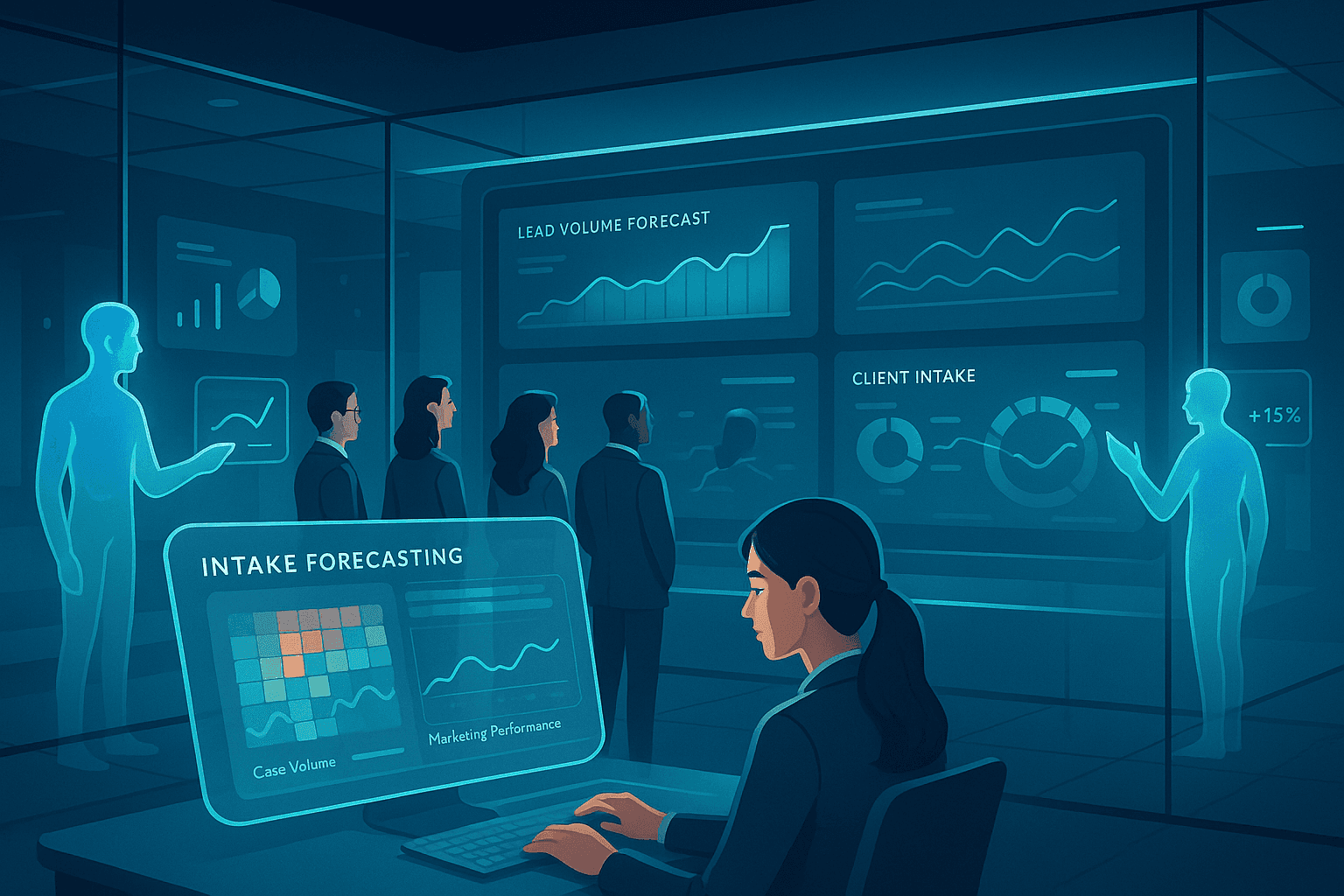
Legal intake forecasting AI marks a leap forward in the way law firms predict and manage their future client demand and case volume. By leveraging artificial intelligence to analyze historical client intake data, marketing performance, and inquiry trends, law firms can now forecast with unparalleled accuracy. This directly impacts crucial business aspects: resource allocation, marketing budget strategies, and overall operational planning.
Learn more here
Traditional forecasting in law firms has depended largely on managerial intuition or basic averages from previous periods. These static methods miss the interplay between diverse factors—like sudden market shifts, complex seasonal trends, or simultaneous effects from multiple overlapping marketing campaigns. As a result, they leave firms exposed to operational inefficiency and lost revenue opportunities.
Legal intake forecasting AI transforms this process by integrating more variables and continuously adapting to new, real-time data. This enables law firms to:
Optimize marketing spend by predicting which channels will perform best and when.
Ensure appropriate staffing based on accurately forecasted lead and case volume.
Enhance profitability by minimizing idle capacity and reducing missed opportunities.
The aim of this blog post is to help law firms harness legal intake forecasting AI for more precise lead and case volume predictions—enabling them to optimize marketing, scale staffing, and anticipate client demand for a significant competitive advantage.
Learn more here
Section 1: Overview of Lead Volume Prediction in Law Firms
Lead Volume Prediction Law Firms: Defining the Process & Its Challenges
Lead volume prediction law firms is the process of estimating how many potential clients will contact or engage a law firm over a future period, and how those leads will convert into cases. Most firms have traditionally performed future case volume prediction legal based on:
Historical intake averages (number of leads/cases per past month or season)
Leadership experience or subjective recall
Ad-hoc manual reviews of spreadsheets or CRM exports
Problems with Traditional Forecasting
However, these methods present challenges—especially at scale:
Data fragmentation: Intake and lead info often reside in silos (email, calls, web forms, multiple CRMs), resulting in incomplete pictures.
Missed seasonality/cyclical patterns: Simple averages overlook recurring surges or dips (e.g., more family cases right after holidays).
Attribution complexity: It’s tough to discern which specific marketing touchpoint (social, search, referral) truly drove a converted lead.
Insufficient pattern detection: Static models can’t process the intricate, sometimes non-linear relationships between dozens of data variables.
Traditional, intuition-driven forecasting yields limited insight and leaves firms reacting rather than planning proactively.
Why AI-Driven Forecasting Is a Solution
Legal intake forecasting AI is fundamentally different. It leverages robust machine learning algorithms to:
Ingest data from every available source (CRMs, phone logs, marketing dashboards, case management tools)
Analyze thousands of variables and interactions
Recognize hidden correlations (e.g., spike in tax law inquiries after regulatory changes)
Refine predictions in real time as new data enters the system
This results in dynamic, highly accurate forecasts of both lead and case volume—enabling better decisions across the entire firm.
Section 2: The Role of AI in Client Demand and Intake Forecasting
AI Client Demand Forecasting: How AI Drives Legal Intake Forecasting AI and Intake Trend Analysis Attorneys
AI client demand forecasting for law firms uses machine learning to forecast when and where client inquiries and new case openings will peak or drop, with accuracy far beyond past methods.
Learn more here
Core Data Inputs Used by Legal Intake Forecasting AI
AI-powered systems synthesize datasets including:
Marketing Performance Metrics: Conversion rates, cost-per-lead, channel ROI, ad impressions, campaign timing.
Historical Intake Data: Volume of leads, case types, demographic details, conversion rates, matter outcomes.
Seasonal/Temporal Patterns: Trends by month, week, or day; multi-year cycles.
External Market Data: Economic shifts, regulatory updates, competitor activity, policy/news events.
Client Interaction Data: Source of inquiry, response time, region/geography, communication touchpoints.
By merging these datasets, legal intake forecasting AI illuminates nuanced client demand patterns no human could detect.
How AI Finds Nuanced Patterns
Consider an example: AI might reveal social paid ads tend to drive more PI leads during January–March (post-holiday season), while referral sources contribute more in late summer. Or, the system could show immigration case inquiries spike regionally after new policy announcements.
Benefits of AI-Driven Forecasting for Attorneys
Legal intake forecasting AI provides the following advantages:
Greater forecasting accuracy by linking all available data using advanced pattern recognition (catching interactions that humans miss).
Timely, adaptable insights: Models self-update as new intake or campaign data appears—enabling mid-month pivots.
Resource optimization: Reliable demand predictions guide hiring, scheduling, and budget allocation—preventing both understaffing and wasted spend.
These features allow for proactive, rather than reactive, business management.
Explore further
More on AI legal intake
Section 3: Legal Marketing Pipeline Optimization Using AI
Legal Marketing Pipeline AI: Enhancing Lead Volume Prediction Law Firms & Future Case Volume Prediction Legal
Legal marketing pipeline AI uses forecast data to refine all parts of the marketing and intake funnel—from discovery to engagement. This approach allows law firms to:
Predict exactly when and where to invest marketing dollars.
Adapt messaging and channels for seasonal case types.
Allocate staff to manage forecasted intake surges.
How Forecasts Tailor Legal Marketing Efforts
When AI predicts an uptick (e.g., personal injury leads after winter storms), law firms can:
Increase targeted ad spend during forecasted high-lead windows (e.g., December-January).
Boost temporary staff or extend intake call center hours.
Switch landing pages or ad messaging to match the predicted case types or demographics.
Pause high-cost acquisition campaigns during anticipated low seasons and focus on referrals or nurturing past clients.
Example Scenarios of AI-Driven Pipeline Optimization
- A personal injury firm notices a 35% intake surge in January. AI helps the firm:
Increase ad spend before the spike.
Deploy more intake staff.
Adjust website CTAs for higher conversion.
Preload attorney calendars for assessments.
- During low periods, AI suggests reallocating resources to nurture prior clients, build referral networks, or test new channels—maximizing every marketing dollar.
Dynamic, ROI-Driven Funnel Management
Pipeline AI doesn’t just forecast volume—it guides every marketing and staffing decision, keeping lead quality and conversion high while minimizing wasted marketing expense.
Deep dive: AI and the legal intake funnel
Section 4: Intake Trend Analysis for Attorneys
Intake Trend Analysis Attorneys: Proactive Practice Planning with AI Client Demand Forecasting & Legal Intake Forecasting AI
Intake trend analysis attorneys refers to the systematic, AI-driven review of client inquiry, demographic, and case data to anticipate changes in demand.
Learn more here
How AI Detects and Interprets Patterns
AI-based intake trend analysis enables law firms to discover:
Seasonal spikes by practice area: E.g., real estate surging in summer, family law post-holidays, injury cases after storms.
Correlation with external triggers: Detect spikes in data privacy cases after breaches, or immigration inquiries post-policy news.
Real-time trend detection: See upticks in niche practice areas (like cryptocurrency litigation or AI compliance) before competitors.
Geographic and Regional Insights
For multi-location firms, trend analysis uncovers:
Different cycles by region: Winter accident claims higher in the Northeast; summer incidents spike in the South.
Multi-year cycles: Construction, real estate, or employment case demand tied to broader economic or regulatory events, visible in the data over multi-year patterns.
How These Insights Drive Decisions
Intake trend analysis attorneys support smarter:
Hiring and training: Prepare recruiting/education for anticipated demand in certain practice areas.
Resource shift: Reassign staff and attorneys where forecasted demand increases or declines, maximizing firm efficiency and reducing layoffs.
These capabilities give firms a decisive, proactive planning edge.
Section 5: Predicting Future Case Volume with AI
Future Case Volume Prediction Legal: Effortless Planning with Legal Intake Forecasting AI
Predicting future case volume means understanding not just raw leads, but the full lifecycle and projected workload for every active and upcoming case—a crucial step for advanced firm management.
AI’s Integration With Case Lifecycle Data
Legal intake forecasting AI combines lead forecasts with historical data on average case duration per practice area:
Personal injury: e.g., 18 months on average.
Employment: e.g., 14 months.
Family law: e.g., 24 months.
This allows AI to forecast:
Active case inventory at any future date.
Expected workload (hours, staff, attorneys needed).
Overlapping case cycles, eliminating bottlenecks or idle staff.
How Future Volume Predictions Optimize Operations
Budgets can scale accurately with predicted case numbers (technology spend, office space, vendor contracts).
Staffing is proactive: Full-time, part-time, or temp hiring is scheduled months ahead.
Resource allocation is smarter: Surplus staff can be moved to busier areas; cross-training is prioritized over layoffs.
Client service and satisfaction increase: Timely responses and case progress aren’t held up by unanticipated surges.
Accurate forecasting makes law firm operations predictable, preventing reactive cost overruns or missed revenue opportunities.
Section 6: Practical Steps for Law Firms to Implement Legal Intake Forecasting AI
Legal intake forecasting AI isn’t out of reach, nor does it require a total system overhaul. Here’s how law firms can proceed—step by step:
Step-by-Step: Adopting Legal Intake Forecasting AI
Audit your data locations:
Pinpoint all places where intake data lives: CRMs, case management, emails, phone systems.
Centralize intake:
Feed all lead sources into one unified, searchable system—ideally a robust CRM.
Deploy AI-powered intake tools:
Use platforms that record every possible intake detail (source, channel, demographics, case type, marketing attribution).
Integrate with case management:
Ensure your intake system syncs perfectly with ongoing case management so leads become cases, and both datasets improve model prediction.
Train your team:
Educate attorneys, intake specialists, and marketing staff on interpreting AI-driven insights and adjusting strategies accordingly.
Monitor and refine:
Continuously measure forecast accuracy, update KPIs, and tweak AI configurations to maintain peak performance.
Data and Modeling Best Practices
Standardize intake fields: Avoid free-text notes; use dropdowns, checkboxes, and required fields for consistency.
Capture all context: Every lead entry should have source attribution, conversion tracking, and detailed timestamps.
Clean historic data: Remove duplicates, fix errors, and fill gaps before introducing AI models—garbage in, garbage out.
Baseline KPIs:
Leads per month (by source and practice area)
Conversion rates and time to sign
Average case value & duration
Pipeline optimization insights
Tracking Success: KPIs to Measure Impact
Forecast accuracy: Aim for 80%+ match to actuals within forecasting windows.
Lead quality: Higher conversion rates and increased case value per lead.
Resource utilization: Decreased excess idle or overworked staff cycles.
Marketing ROI: Increased revenue per dollar spent, improved attribution of spend to signed cases.
Client satisfaction: Faster response, quicker resolution, better client reviews.
Revenue predictability: More stable, less volatile cash flows.
Conclusion: Legal Intake Forecasting AI—Lead Volume Prediction Law Firms, AI Client Demand Forecasting, Legal Marketing Pipeline AI, Intake Trend Analysis Attorneys, Future Case Volume Prediction Legal
Legal intake forecasting AI revolutionizes law firm business operations by turning gut-feel guesses and static averages into live, high-accuracy predictions of lead and case volume. With real-time intake trend analysis, deep AI client demand forecasting, and smart legal marketing pipeline AI, proactive firms eliminate wasted resources, reduce operational risk, and guide every business decision with data.
Resource allocation and hiring can be planned months ahead of time.
Marketing budgets stretch further, targeting the right leads, at the right time, on the right channels.
Operational risk drops—no more fire-drills after surprise intake spikes, or underused staff after seasonal volume dips.
Client satisfaction soars as cases move rapidly through well-staffed, well-organized pipelines.
The firms implementing future case volume prediction with AI are leading their markets, not following. They’re less reactive, more resilient, and more client-centric—poised to win the competition for top clients and talent.
Law firms: It’s time to move from manual forecasting toward AI-powered precision. Begin your journey today—standardize your intake, unify your data, and explore world-class legal intake forecasting AI.
Ready for the next step?
Book a personalized demo of LawHustle and transform your intake forecasting AI at:
https://golawhustle.com/demo
Further reading: AI-based legal predictions
Automated legal intake with AI
FAQ
What is legal intake forecasting AI?
Legal intake forecasting AI uses machine learning algorithms to analyze historical and real-time client intake data, marketing metrics, and external factors. It predicts future lead volume and case demand, enabling law firms to optimize resources, staffing, and marketing efforts with greater accuracy.
How does AI improve lead volume prediction compared to traditional methods?
Unlike traditional methods that rely on averages or intuition, AI ingest vast, fragmented datasets from multiple sources. It detects complex, non-linear patterns and adapts in real time to new data, resulting in highly accurate and actionable forecasts.
What are the key benefits of using AI for law firm marketing?
AI enables law firms to target marketing spend strategically by predicting lead surges and seasonal case types. It helps optimize campaign timing, messaging, and channel allocation, resulting in higher conversion rates, reduced wasted spend, and better return on investment.
How can law firms implement legal intake forecasting AI effectively?
Firms should start by auditing and centralizing intake data across all sources, then deploying AI-powered intake platforms integrated with case management. Training staff on AI insights and continuously monitoring and refining predictive models ensures successful adoption and value realization.
What KPIs should be tracked to measure AI forecasting success?
Important KPIs include forecast accuracy (targeting 80%+), lead quality and conversion rates, resource utilization efficiency, marketing ROI, client satisfaction, and revenue predictability for stable cash flow management.