Written by : Chris Lyle
Dec 18, 2025

Estimated reading time: 14 minutes
Key Takeaways
Legal intake jurisdiction detection AI enhances accuracy and speed in screening client leads for multi-state compliance, reducing ethical and regulatory risks.
Unauthorized state lead screening prevents violations by blocking or flagging leads from jurisdictions where the firm lacks licensure.
Practice location compliance AI ensures intake and onboarding comply with jurisdiction-specific laws and bar rules, improving auditability and operational efficiency.
Integration of AI-powered intake blockers across all client contact channels safeguards firms against unauthorized practice of law and malpractice exposure.
Human oversight remains critical to review ambiguous jurisdiction cases and override AI decisions when necessary.
Best practices include tool selection, policy design, staff training, and continuous updating for sustained and defensible compliance.
Table of Contents
Introduction: Legal Intake Jurisdiction Detection AI in a Multi-State Law World
The Ethical and Legal Risks of Unauthorized State Lead Screening
How Legal Intake Jurisdiction Detection AI Works
The Role of Unauthorized State Lead Screening
Benefits of Practice Location Compliance AI
Implementing an Intake Blocker for Wrong State Legal Leads
Best Practices for Integrating Jurisdiction Detection AI Into Your Law Firm
Case Studies and Hypothetical Examples
Conclusion: Secure Compliance Through Legal Intake Jurisdiction Detection AI
FAQ
Introduction: Legal Intake Jurisdiction Detection AI in a Multi-State Law World
Legal intake jurisdiction detection AI is a cutting-edge solution enabling law firms to quickly and accurately screen client leads for jurisdiction compliance, preventing ethical risks and regulatory violations. As law firm operations rapidly expand across multiple states—driven by remote consultations, online marketing, and national advertising learn more—maintaining practice location compliance has become a high-stakes concern for all law firms.
Multi-state and virtual law firms face unique challenges: taking a lead from the wrong state can trigger unauthorized practice of law violations, bar complaints, or even nullify client engagements. For modern practices, every intake is a compliance event—one misstep can have severe repercussions. (source)
Traditional manual compliance checks—relying on staff to interpret calls, forms, or emails—are no longer sufficient. As intake volume, lead sources, and jurisdictional complexity grow, so does exposure to risk and the opportunity for error. Multi-state practices now require the speed, accuracy, and audit-grade rigor that can only be delivered through legal intake jurisdiction detection AI and practice location compliance AI. These sophisticated systems automate and enforce proper lead jurisdiction screening, safeguarding your law firm from ethical violations and operational inefficiencies.
In this comprehensive guide, we’ll examine what legal intake jurisdiction detection AI is, how it works, the ethical and practical risks it addresses, and how your firm can implement jurisdiction screening for reliable compliance in a multi-jurisdictional legal environment.
(source)
The Ethical and Legal Risks of Unauthorized State Lead Screening
What is an Unauthorized State Lead?
Unauthorized state lead screening refers to the process of identifying and managing leads from jurisdictions where your firm is not licensed to practice law. An unauthorized lead is any client matter originating in a jurisdiction where your law firm or any of its attorneys lack active licensure or authority.
Concrete Compliance and Risk Scenarios
Failing to detect and block unauthorized leads exposes your firm to serious consequences:
Unauthorized Practice of Law (UPL) Allegations:
Accepting a case from an unlicensed jurisdiction can result in state bar complaints, heavy fines, suspension, or disbarment.
Legal Malpractice Exposure:
Giving legal advice under the wrong state’s law, or appearing before a court without authority, invites malpractice claims and liability.
Fee Disputes/Unenforceable Agreements:
Legal fee agreements or retainer contracts may be voided if representation occurred without proper licensure.
Regulatory Scrutiny:
Improper advertising, solicitation, or cross-border practice may bring investigations and sanctions by state bar regulators.
Example: A lead from Florida is accidentally accepted by a New York-only practice due to an ambiguous web form. If the attorney proceeds, both malpractice exposure and UPL risk are triggered—potentially voiding all client engagement and fees. (source)
Manual Screening Challenges
In high-volume, multi-jurisdiction settings, staff must try to deduce jurisdiction from:
Client phone number (may not represent legal venue)
Address or ZIP (error-prone in cross-border metros or with P.O. Boxes)
IP or browser geolocation (not always reliable, especially with VPNs)
Subtle fact patterns in intake calls/emails
These processes are slow, subjective, and lead to inconsistent screening learn more. As volume scales, errors and compliance failures multiply: staff fatigue, inconsistent procedures, missed disclosures, and non-uniform handling all increase risk. (source)
Why Automation is Necessary
Given these stakes, firms require automated, reliable legal intake jurisdiction detection AI and unauthorized state lead screening to systematically eliminate human error, enforce best practices, and create an indisputable audit trail throughout the client intake process read more.
(source)
How Legal Intake Jurisdiction Detection AI Works
Key Components: Bar License Region Checker AI and Practice Location Compliance AI
Legal intake jurisdiction detection AI is a combination of advanced data extraction, automated rules engines, and always-updating license maps. Together, these components deliver near-instant, accurate, and scalable compliance at the first point of client contact.
1. Geographical Origin Detection
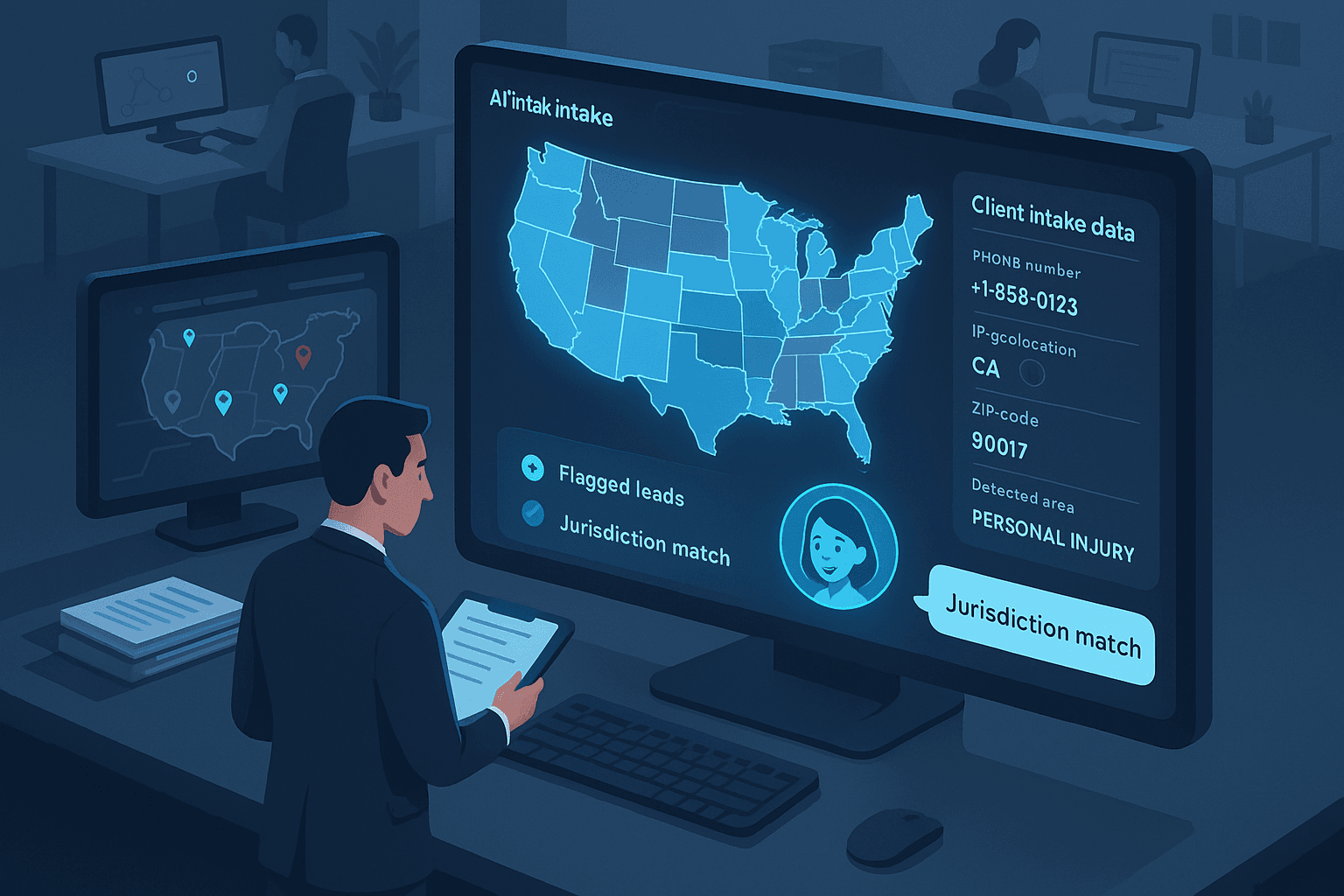
AI-driven intake workflows extract and synthesize multiple data points to determine the relevant legal jurisdiction:
Provided address or ZIP code
Phone number metadata (including area code and telecom registration)
Browser/device geolocation and IP analysis
Incident location described in intake facts
Time zone, language preference, and other client metadata
Jurisdiction-aware chatbots can detect this data in real time learn more, then adapt intake questions and disclaimers based on recognized geography. The moment a California case is sensed, all follow-up questions and disclosures become California-law specific. (source, source)
2. Bar License Region Checker AI
This component maintains a structured, up-to-date map of:
Where each attorney is licensed
Status (active/inactive/special permissions such as pro hac vice)
Which practice areas are covered in each jurisdiction
When a lead is detected, the AI cross-references it with the bar license region checker AI. If the client’s state matches a licensed location for the submitting attorney/team, the lead progresses. Otherwise, it's flagged for referral or automatically declined. This system:
Reduces missed or inaccurate license checks
Dynamically updates as attorneys join/exit or licenses change
Logs every screening for audit purposes
3. Cross-Referencing Compliance
Legal intake jurisdiction detection AI encodes state-specific rules, practice area limits, firm policies, and required disclosures, including:
“We only handle employment law in Illinois, not Indiana”
“We have pro hac vice permissions in Texas courts for specific cases”
Based on detected jurisdiction, intake scripts and client messaging adapt dynamically. Any mismatch is immediately flagged for human review, with all actions logged for later audit. ---- See also form guidance.
4. Human Oversight
No AI is perfect. Legal intake jurisdiction detection AI is designed to escalate ambiguous or “gray area” jurisdictional cases for human review. Attorneys and managers remain able to verify or override AI determinations as needed, ensuring exceptional care on edge cases read more.
The Role of Unauthorized State Lead Screening
What is Unauthorized State Lead Screening and Intake Blockers?
Unauthorized state lead screening is an AI-enabled process that identifies, flags, and, when appropriate, blocks leads from “out-of-footprint” jurisdictions—those where your law firm is unauthorized to practice—at the first moment of client contact.
How Automated Out-of-Footprint Screening Works
Immediate Jurisdiction Assessment:
Upon lead entry via web forms, chat, phone, or email, the system instantly evaluates the originating state or region.Real-Time Triage:
Flag for Manual Review: Leads from gray zones or with incomplete location data.
Block Unauthorized Progression: Leads from clearly unlicensed states are stopped—before consultation, engagement, or even conflict screening.
Custom Disclaimers: Chatbots and web forms automatically present state-specific notices (e.g., “We do not practice in your state. Here’s a referral resource”) learn more.
Seamless Integration:
The process applies across all intake channels—including after-hours answering services or third-party chatbots.
Value Outcomes
Saves Firm Resources: Prevents non-compliant matters from consuming attorney/bookkeeping time.
Reduces Regulatory and Malpractice Risk: Stops UPL exhibition at the source, and demonstrates active, defensible compliance to state bar authorities.
Enhances Client Experience: Even declined leads receive timely, accurate information and next steps. See “One Simple Way to Understand Automated Legal Intake” read more.
(source, source, source, source)
Benefits of Practice Location Compliance AI
Why Use Practice Location Compliance AI?
Practice location compliance AI is a comprehensive set of automation and validation tools ensuring your intake, engagement, and onboarding procedures strictly align with laws and bar rules of every jurisdiction in which you operate.
Key Benefits
Stronger Regulatory and Ethical Compliance:
AI auto-enforces state-specific rules, required disclaimers, and engagement language.
Eliminates UPL and inadvertent venue or notice rule mistakes.
Ensures correct attorney assignment per state and matter learn more.
Reputational and Audit Advantages:
Every jurisdictional determination, flag, block, or manual override is logged. This strengthens your firm’s position in audits, bar or insurer reviews.
Clients receive consistent, professional messaging regardless of location.
Increased Efficiency and Scalability:
Automation slashes intake time—allowing your firm to handle more leads with fewer errors or bottlenecks.
Filters only jurisdiction-compliant matters into your CRM/case management.
Frees up attorneys and staff to focus on qualified leads and substantive work.
Pre-Screening for Additional Requirements:
Practice location compliance AI can screen by case type (e.g., personal injury, employment), deadlines (e.g., statute of limitations), or special local notice rules.
Enables faster, smarter routing to the right attorney/office. For an overview of workflow automation, see “The How-To of Legal Workflow Automation” learn more.
(source, source, source, source)
Implementing an Intake Blocker for Wrong State Legal Leads
Function and Integration of an Intake Blocker
An intake blocker for wrong state legal leads is an AI-powered gateway that prevents unauthorized leads from ever entering your CRM, calendar, or case pipeline.
How Intake Blockers Operate
Integration Across All Intake Channels:
Website forms
Live and AI-driven chatbots learn more
Phone-answering scripts (with dynamic location prompts)
Direct email or SMS-to-intake conversion
Automated Jurisdiction & License Checks:
Every new lead runs through jurisdiction detection and a bar license region checker AI.
If the origin matches licensed states—lead proceeds to jurisdiction-specific intake and disclosure flow.
If lead is from an unauthorized state:
Block CRM/Matter Creation: No matter record or appointment is created.
Decline/Referral Workflows: Lead is routed to a non-engagement message, referral partner, or helpful content.
Custom Client Messaging: Even declined leads receive tailored, actionable responses (not generic rejection).
Consistent Application:
Law firms achieve consistency and increased staff capacity by removing subjective intake decisions and ensuring uniform screening at every entry point.
Example Workflow:
Incoming Lead: Web form declares a Mississippi case, but the firm only practices in Alabama and Louisiana.
Blocker Checks Map: Confirms “MS” is out-of-footprint.
Client Experience: Web or chatbot displays, “We cannot currently advise on matters in Mississippi. Here are referral resources.” No consultation is booked, and the matter is not entered into the CRM.
(source, source, source, source)
Best Practices for Integrating Jurisdiction Detection AI Into Your Law Firm
1. Tool Selection for Legal Intake Jurisdiction Detection AI
Key Features to Demand:
Reliable location/jurisdiction extraction from multiple intake sources (source)
Adaptive forms and chatbots customized by state/practice area learn more
Seamless integration with your CRM/case management systems (source)
Configurable rule engines for every compliance nuance
Proven data security, client confidentiality, and attorney-client privilege compliance (source)
2. Policy & Workflow Design with Practice Location Compliance AI
Define:
All accepted, referred, and declined jurisdictions and practice areas
Disclosures, conflicts, and audit-logging policies
Encode policies into the AI, ensuring automated, consistent screening
Set up clear escalation criteria for “unknown/uncertain” cases—route these immediately for attorney oversight (source)
3. Staff Training and Human Oversight
Train all staff on:
AI decision logic and review/override processes
Recognizing when to escalate to attorneys (e.g., cross-border or pro hac vice scenarios)
Handling AI-referral workflows and client communication learn more
Periodically audit the system for accuracy and bias; human sign-off on high-risk or unfamiliar matters (source)
4. Continuous Monitoring and Updating
Regularly update attorney license information and practice footprint in bar license region checker AI
Adjust rule sets as attorneys are hired, leave, or jurisdiction laws change
Review audit logs for patterns, missed cases, or repeated exceptions—improve rule sets accordingly (source)
Implementing these best practices ensures that your intake blocker for wrong state legal and jurisdiction detection AI remain accurate, defensible, and adaptive as your firm grows.
(source, source, source, source)
Case Studies and Hypothetical Examples
Example 1: Nationwide Plaintiff Firm
Firm Profile: PI firm licensed only in CA, NV, AZ, but running ads in 50 states
Web and chatbot intake forms check ZIP & incident location using legal intake jurisdiction detection AI
Leads in CA/NV/AZ progress to appropriate attorney with state-adapted intake and disclosures
Leads from other states are flagged for referral, routed to general FAQs, and are prevented from reaching consultation calendars (automated unauthorized state lead screening)
Firm audit logs demonstrate every declined/blocked lead—no UPL risk, and seamless client redirection
Keywords: legal intake jurisdiction detection AI, unauthorized state lead screening
Example 2: Regional Business Law Firm Expanding Licensing
Firm Profile: Mid-sized firm growing from one to five states as partner attorneys join
Bar license region checker AI auto-updates routing matrix in real time
Business formation inquiries from Delaware or New York routed to relevant newly admitted attorney
State-specific engagement letters and onboarding steps served automatically depending on client origin
Staff focus on substantive casework rather than manually mapping jurisdiction/license, with practice location compliance AI handling the rest
Keywords: bar license region checker AI, practice location compliance AI
Conclusion: Secure Compliance Through Legal Intake Jurisdiction Detection AI
In the new multi-state practice landscape, legal intake jurisdiction detection AI, unauthorized state lead screening, practice location compliance AI, and a robust intake blocker for wrong state legal leads are essential safeguards. These tools let you:
Instantly determine where each potential client’s matter arises
Cross-reference attorneys’ licensure on the fly
Block or reroute out-of-jurisdiction leads before they become ethics or UPL risks
Create audit logs for defensibility with state bars, insurers, and clients
Consistently deliver compliant, state-adaptive client messaging
By adopting AI-powered intake screening, your firm proactively eliminates compliance gaps, reduces subjective intake errors, and accelerates intake for clients you can represent. These improvements not only protect your reputation and bottom line but enable your practice to scale confidently across jurisdictions without legal or ethical missteps.
Law firms that move quickly to implement these technologies will gain operational advantages and peace of mind as regulatory pressures grow.
Future-proof your law firm’s compliance and intake processes: Book a demo of LawHustle’s AI-powered intake screening now and see how you can protect your practice while delivering superior client service.
FAQ
What is legal intake jurisdiction detection AI?
Legal intake jurisdiction detection AI is an advanced technology that automatically screens client leads to determine the correct legal jurisdiction for a matter. It cross-references client data with attorney licensure and bar regulations to ensure compliance and reduce risks of unauthorized practice of law.
Why is unauthorized state lead screening important for law firms?
Unauthorized state lead screening helps law firms avoid serious ethical and legal consequences such as bar complaints, malpractice claims, and unenforceable fee agreements by preventing intake of clients from jurisdictions where the firm is not licensed to practice.
How does practice location compliance AI benefit law firms?
Practice location compliance AI ensures all client intake, engagement, and onboarding strictly follow the laws and rules of each jurisdiction. It increases efficiency by automating screenings and routing while providing audit logs that enhance defensibility during reviews and investigations.
Can humans oversee and override AI decisions?
Yes. Human oversight is integral to the system, allowing attorneys or managers to review ambiguous or borderline cases and override AI decisions to ensure accurate and ethical client intake.
How do I implement intake blockers for wrong state legal leads?
You implement intake blockers by integrating AI-powered jurisdiction detection and license checks across all intake channels such as web forms, chatbots, phone scripts, and email. Unauthorized leads are automatically flagged or blocked before entering the firm’s CRM or case management systems, with customized client messaging and referral workflows.