Written by : Chris Lyle
Dec 15, 2025

Estimated reading time: 12 minutes
Key Takeaways
Legal webinar personalization AI transforms how law firms engage with clients by leveraging intake data, smart reminders, and automation.
Intake data webinar targeting enables hyper-personalized content and invitations based on detailed client profiles and behavior.
Smart reminders for legal events reduce no-shows by delivering AI-optimized notifications tailored to attendee behavior and preferences.
AI-driven post-event follow-up nurtures leads with personalized, timely outreach, automating client relationship growth.
Interactive legal webinar automation enhances live participation through AI-powered Q&A management, polls, emotion analysis, and personalized journeys.
Integrating AI across webinar workflows delivers measurable ROI via increased attendance, engagement, conversions, and staff efficiency.
Table of Contents
Introduction: Legal Webinar Personalization AI & the Power of Intake Data
Understanding Legal Webinar Personalization AI
Using Intake Data for Webinar Targeting
Implementing Smart Reminders for Legal Events
AI-Driven Post-Event Follow-Up for Law Firms
Interactive Legal Webinar Automation
Benefits and ROI of Integrating AI in Legal Webinars
Conclusion: Why Law Firms Need Legal Webinar Personalization AI Now
Sources
FAQ
Introduction: Legal Webinar Personalization AI & the Power of Intake Data
Legal webinar personalization AI is fundamentally transforming how law firms engage with prospective and existing clients during virtual events. By harnessing AI technology, law firms can now create webinars that are tailored to each attendee—leveraging data from initial intake forms all the way through to post-event follow-up.
This approach empowers legal marketers to move beyond generic presentations and instead use intake data webinar targeting, smart reminders for legal events and AI event follow-up to deliver interactive legal webinar automation at scale. As a result, attendees see content that resonates, receive timely nudges to join events, and benefit from meaningful post-event outreach. Law firms, in turn, enjoy increased attendance, heightened engagement, and higher conversion rates.
Why is this shift so significant?
AI-powered targeting uses detailed intake and behavioral data to segment audiences and select hyper-relevant webinar topics.
Smart reminders and event automation ensure registrants attend and participate by delivering cues at optimal times.
AI-driven follow-ups transform one-off webinar attendees into nurtured prospects by tailoring content and outreach to individual actions.
Personalization deepens client engagement and delivers measurable ROI for law firms looking to maximize their virtual event investments. According to research by Airmeet, dynamic, AI-driven personalization has a direct, positive impact on webinar attendance, engagement, and post-event conversion rates—making it indispensable for modern legal practices (Airmeet, ContractPodAi).
Understanding Legal Webinar Personalization AI
Defining Legal Webinar Personalization AI
Legal webinar personalization AI combines artificial intelligence with legal marketing to create bespoke webinar experiences. At its core, this means:
Integrating AI into a law firm’s webinar workflows
Analyzing client intake data, including demographic information, practice area interests, historic interaction patterns, and expressed preferences
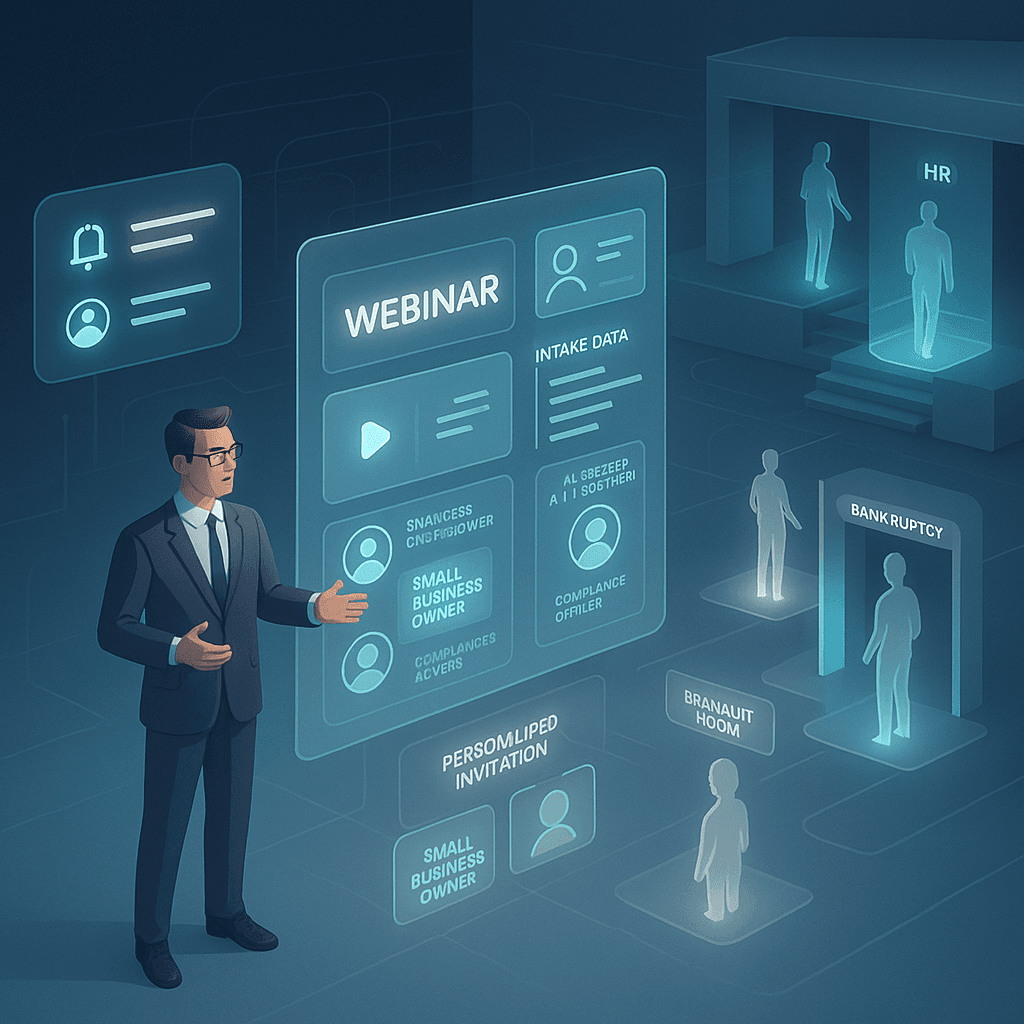
Using this analysis to target content, invitations, reminders, and post-event outreach to the right segments—be they compliance officers, small business owners, or individual clients
With legal webinar personalization AI, the traditional one-size-fits-all approach is replaced by intelligent segmentation. AI uncovers client needs by:
Reviewing large data volumes to detect patterns (e.g., repeated attendance at IP law events points to IP interest)
Mirroring advanced techniques from AI legal document review, such as anomaly detection and clustering, for audience segmentation
Manual vs. AI-Driven Targeting
Manual Targeting: Relies on broad guesswork or static filters (like location or practice area) and is slow, error-prone, and superficial.
AI Segmentation: Instantly processes granular data, achieving higher accuracy and deeper personalization for better client experiences.
The result is a legal webinar experience that feels uniquely relevant to each participant, increasing the likelihood of participation and conversion (Airmeet, ContractPodAi).
Using Intake Data for Webinar Targeting
Intake Data Webinar Targeting: Customizing Content for Results
Intake data webinar targeting takes the power of legal webinar personalization AI a step further by drilling deep into each attendee’s intake profile and behavior history. Here’s how it works:
Intake Form Analysis: AI captures and analyzes client-submitted data (such as areas of legal concern, business type, and preferred communication channels).
Behavioral Signals: Pulls in past event data, such as topics attended, poll responses, and engagement levels.
Intent Recognition: Uses machine learning models and natural language processing (NLP) to detect intent from qualitative answers or patterns.
AI Targeting in Action
Topic Curation: When intake data shows a registrant is concerned with bankruptcy law, they receive invitations crafted for bankruptcy Q&A sessions or recent legislative updates.
Customized Invitations: HR professionals who attended a compliance webinar in the past get invites for HR compliance workshops instead of general legal briefings.
Dynamic Lists: AI perpetually updates targeting lists based on freshest interactions, ensuring the right content reaches the right people.
Business Value:
Increases Registration Rates: Matching content to individual interests and needs
Boosts Attendance: Because invites reflect actual intent and priorities, not vague segments
Enables Effective Follow-up: AI predicts who is most likely to engage further, allowing targeted nurturing
AI targeting means law firms no longer send “spray and pray” invites. Instead, every communication is purposeful, grounded in actionable data (Airmeet, ContractPodAi).
Implementing Smart Reminders for Legal Events
Smart Reminders Legal Events: Reducing No-Shows and Driving Engagement
No-shows are common in law firm webinars. Smart reminders for legal events tackle this head-on by using AI to automate when and how reminders are sent, based on nuanced behavioral patterns detected through legal webinar personalization AI and intake data webinar targeting.
What Are Smart Reminders?
AI-driven notifications that adapt to user behavior in real-time
Key Features:
Delivery Optimization: AI analyzes recipient behavior, including email open rates, ignored reminders, preferred device, and historic last-minute registration activity.
Real-Time Adjustment: If someone failed to answer polls or dropped off early during past sessions, AI tweaks the timing or content of reminders for better pickup.
Dynamic Channels: Decides if SMS, push notification, or email will elicit the best response, reducing manual guesswork for staff.
Behavior-Based Personalization
Reminders might be spaced closer together for high-propensity prospects or slowed for those showing “reminder fatigue.”
Content (e.g., “Here’s what you’ll learn based on your interests in employment law!”) changes to echo the user’s stated preferences or prior webinar behavior.
Business Advantages:
Reduces No-Show Rates: By contacting registrants at their peak engagement times
Maximizes Attendance: Timely, relevant reminders keep the event top-of-mind
Cuts Admin Time: AI takes the reins with minimal human involvement
For law firms hosting frequent virtual events, these AI-powered reminders are crucial in maximizing participation and stretching marketing ROI learn more.
AI-Driven Post-Event Follow-Up for Law Firms
AI Event Follow-Up Law Firms: Nurturing Leads with Personalization
What happens after your legal webinar ends is just as important as the event itself. With AI event follow-up, law firms can turn fleeting webinar interactions into enduring client relationships.
How AI Drives Post-Event Follow-Up
Maps Engagement to Profiles: AI interprets attendee actions (questions asked, poll responses, session duration) and cross-references with intake data
Prioritizes Outreach Efforts: Those who asked detailed compliance questions might receive a checklist or personalized consultation offer, not just a generic “thank you”
Automates Follow-Up Streams: Emails, calendars for follow-up calls, or packets of relevant guides/resources are generated and sent automatically
Lead Nurturing Benefits:
Timely Contact: The faster and more relevant the follow-up, the more likely it is to convert a lead to a client.
Personalized Messaging: Instead of mass emails, recipients get tailored communications reflecting their exact event behavior and stated needs.
Compliance and Trigger Awareness: AI looks for compliance risk markers in both intake forms and webinar chat/Q&A, enabling proactive follow-up with regulatory alerts or resource packs.
Results for Law Firms:
Higher Conversion Rates: Prospects receive the exact value they sought from the event, making them more likely to act.
Less Manual Work: Automated systems handle outreach flows, freeing marketing and legal staff to focus on complex, relationship-driven work.
AI event follow-up is the lynchpin in a seamless digital client experience, ensuring your webinars generate real business and measurable ROI learn more.
Interactive Legal Webinar Automation
Interactive Legal Webinar Automation: Enhancing Engagement with AI
The rise of interactive legal webinar automation means that AI isn’t just working behind the scenes with targeting and reminders—it’s actively orchestrating live experiences. This is where AI and automation meet to create dynamic sessions that engage participants in real time.
Technical Capabilities:
Dynamic Q&A: AI ranks incoming questions based on relevance (context analysis), surfacing the most urgent or popular queries so presenters can prioritize
Automated Polls: Intelligently suggests or launches polls based on audience engagement (if drop-off is detected, a poll might “pop up” to re-engage)
Emotion Analysis: Uses voice tone or text sentiment analytics to gauge group mood, cueing presenters to speed up, clarify, or change direction as needed
Personalized Journeys: Steers users to breakout rooms, downloadable content, or feedback forms that fit their expressed areas of interest or event responses
Legal Use Cases:
Virtual Compliance Trainings: AI automatically breaks large training groups into smaller, relevant topic sessions based on intake answers
Legal Updates & Q&As: Real-time prioritization ensures questions from high-priority attendees aren’t missed
CPD Webinars: Polling and emotion analytics keep regulatory training sessions interactive, preventing “Zoom fatigue”
Results:
Boosted Participation: More engagement through direct, data-driven interactivity
Improved Learning Outcomes: Tailored breakout sessions and resource links drive real knowledge retention
Sophisticated Feedback Loops: AI-processed feedback surfaces actionable event insights to improve future webinars
Interactive legal webinar automation is thus a foundational element of effective, AI-powered virtual event strategy for law firms learn more.
Benefits and ROI of Integrating AI in Legal Webinars
Measuring Value: Legal Webinar Personalization AI in Action
Integrating legal webinar personalization AI across intake, reminders, engagement automation, and follow-ups yields a robust return on investment for law firms. Here’s how to measure the impact:
Major ROI Metrics
Metric | How AI Improves It | Source |
|---|---|---|
Attendance Rates | Increased by personalized invitations & optimal reminders from intake data webinar targeting | |
Engagement Rates | Real-time interactive features (polls, dynamic Q&A, emotion analysis) increase participation | |
Conversion Rates | AI event follow-up law firms send timely, tailored communications to drive actions | |
Time Savings (ROI) | Automation in reminders, follow-ups, and targeting frees up staff for high-value tasks |
Actionable Benefits
More Attendees: AI maximizes registration and minimizes no-shows by matching content and timings to each invitee.
Higher Engagement: Automated polls, customized Q&A, and adaptive session paths keep audiences involved.
Greater Conversions: Personalized post-event actions mean more leads nurtured into retained clients or additional matters.
Staff Efficiency: Automation reduces repetitive tasks—freeing legal marketers to bank more time on ROI-positive relationship building.
Example Law Firm Impact:
A large firm using AI webinar targeting and reminders tracks a 32% year-on-year rise in event attendance.
CPD webinar providers leveraging interactive automation report a 2X increase in completed feedback forms and follow-up consultations.
Post-event AI outreach at a compliance-focused practice sees a 28% uptick in prospect conversions, with marketing hours reduced by half.
Bottom line: legal webinar personalization AI is no longer a “nice to have”—it’s a business-critical strategy for measurable virtual event success. For more on integrating AI across your entire practice, see our ultimate guide on AI in legal practice learn more here.
Conclusion: Why Law Firms Need Legal Webinar Personalization AI Now
Legal webinar personalization AI has emerged as the cornerstone of future-ready legal marketing and client development. Today’s law firms must move fast to leverage:
Intake data webinar targeting: Hyper-personalized invitations and content create relevance from the first interaction.
Smart reminders for legal events: Automated behavioral nudges ensure your audience shows up every time.
AI event follow-up for law firms: Timely, relevant, and personal communications maximize your conversion opportunities.
Interactive legal webinar automation: Dynamic, audience-aware features boost engagement and actionable feedback.
By adopting AI-powered personalization, law firms deliver client-centric experiences that increase satisfaction, foster loyalty, and drive real growth. Every phase—topic selection, marketing, reminders, live interactivity, and follow-up—is enhanced with automation and data-driven insight. This leads to more engaged prospects, smarter business development, and proven ROI (Airmeet, ContractPodAi).
The Time to Act is Now
Clients today expect fast, relevant, and seamless digital experiences. Fall behind, and your competitors will win the business. Stay ahead, and you’ll build the kind of reputation that brings high-value cases and long-term relationships.
Ready to modernize your legal webinars and outperform your competition?
Book a demo of LawHustle now to see how AI-powered webinar personalization can transform your law firm’s events: https://golawhustle.com/demo
Sources
FAQ
What is legal webinar personalization AI?
Legal webinar personalization AI is the use of artificial intelligence combined with legal marketing strategies to create tailored webinar experiences that use client intake data, behavioral analytics, and automation to engage attendees in a highly relevant way.
How do smart reminders reduce no-shows?
Smart reminders use AI to optimize the timing, channel, and content of notifications based on individual attendee behavior and preference, delivering nudges at peak engagement moments and reducing forgetfulness or burnout that lead to no-shows.
What are the benefits of AI-driven post-event follow-up?
AI-driven follow-up personalizes outreach based on attendee interactions during the webinar and intake data, enabling timely, relevant communications that nurture leads effectively, improve conversion rates, and reduce manual workload for staff.
Can interactive legal webinar automation improve engagement?
Yes, by using dynamic Q&A prioritization, automated polls, real-time emotion analysis, and personalized session paths, interactive legal webinar automation keeps participants actively involved and enhances their learning experience.
How do law firms measure ROI from AI in webinars?
ROI is measured by tracking improved attendance rates, higher engagement metrics, increased conversion rates from follow-up outreach, and staff time savings resulting from automation—all supported by data analytics.