Written by : Chris Lyle
Dec 2, 2025

Estimated reading time: 14 minutes
Key Takeaways
Mediation vs litigation intake AI streamlines legal dispute resolution by automating client inquiry classification and routing.
Legal resolution method detection uses AI technologies like NLP and ML to identify the best dispute resolution path—mediation, arbitration, or litigation—at intake.
AI integration reduces human error, accelerates response times, and boosts client satisfaction by matching client preferences with optimal dispute resolution methods.
Client preference routing leverages sentiment analysis and explicit wish detection to respect client autonomy and improve case outcomes.
Dispute resolution path automation enhances firm workflow efficiency by eliminating bottlenecks, customizing follow-ups, and improving case management.
Arbitration screening tools enable targeted identification of arbitration-suitable cases for more granular intake optimization.
Table of Contents
Introduction: Mediation vs Litigation Intake AI and Legal Resolution Method Detection
Understanding Legal Dispute Resolution Methods: Dispute Resolution Path Automation and Legal Resolution Method Detection
Why Dispute Resolution Path Automation and Legal Resolution Method Detection at Intake Matters
Role of AI in Legal Intake Processes: Mediation vs Litigation Intake AI, AI Intake Mediation Inquiries, Legal Resolution Method Detection
Client Preference Routing Legal: Optimizing Routing with Mediation vs Litigation Intake AI
Dispute Resolution Path Automation: Streamlining Workflows with Legal Resolution Method Detection
Arbitration Screening Tool Legal: Automated Screening for Arbitration Suitability
Introduction: Mediation vs Litigation Intake AI and Legal Resolution Method Detection
In today's legal landscape, law firms encounter a persistent challenge from the outset: determining, with speed and accuracy, which legal resolution method—mediation, arbitration, or litigation—best fits each client's case. As legal service demand rises and disputes become more complex, this initial classification is critical. Enter mediation vs litigation intake AI: the advanced technology revolutionizing intake procedures by instantly analyzing client inquiries and routing them to the ideal dispute resolution path. Learn more about AI for lawyers
With legal resolution method detection powered by artificial intelligence, law firms streamline intake workflows, minimize human error, and significantly boost client satisfaction. No longer must intake staff manually interpret every email, phone call, or web form. Instead, smart systems automatically recognize intent and classify leads, making triage immediate and more nuanced than ever.
This post will walk you through the essential dispute resolution methods, the role and value of AI at intake, technical underpinnings of these solutions, and the transformative operational impact for legal professionals. By the end, you'll see why mediation vs litigation intake AI is no longer optional—it's the cornerstone of modern, client-centered legal service.
Understanding Legal Dispute Resolution Methods: Dispute Resolution Path Automation and Legal Resolution Method Detection
Before delving into how AI automates dispute intake, it's vital to clarify the three principal types of legal dispute resolution, each necessitating accurate dispute resolution path automation for optimal outcomes.
Mediation
Definition: A voluntary, confidential, collaborative process where a neutral mediator helps parties communicate and reach mutually acceptable agreements.
Key Features:
Mediator facilitates but does not decide.
Emphasizes speed, lower cost, flexibility, and privacy.
Ideal for cases prioritizing relationship preservation, e.g., commercial partners, family, or employment disputes.
Outcome: Non-binding unless parties formalize agreement.
Use Case: When parties seek control, quick settlement, and want to maintain relationships.
References:
- Bogin, Munns & Munns
- Hartman Law
- McGlone Law Office
Litigation
Definition: The traditional, public court process resulting in binding judgments.
Key Features:
Governed by strict procedural and evidentiary rules.
Involves judges (and sometimes juries) making enforceable decisions.
Fact-finding powers, thorough discovery, potential appeals.
Known for cost, formality, length, unpredictable outcomes.
Outcome: Legally binding as court order/judgment.
Use Case: Required when no voluntary solution is feasible or issues require legal precedent.
References:
- Bogin, Munns & Munns
- HSAG Law
Arbitration
Definition: A hybrid method where a neutral arbitrator hears evidence and delivers a binding (or sometimes non-binding) decision.
Key Features:
More structured than mediation, less formal than litigation.
Parties often select arbitrators with industry expertise.
Viewed as quicker, cheaper alternative to court.
Frequently stipulated in commercial contracts or for cross-border disputes.
Outcome: Binding (by agreement), quick process, limited grounds for appeal.
Use Case: Preferred by parties valuing confidentiality, speed, specialized judgment.
References:
- Bogin, Munns & Munns
- HSAG Law
Why Dispute Resolution Path Automation and Legal Resolution Method Detection at Intake Matters
Resource Allocation: Misclassification wastes expert resources and slows resolution. Learn more about automated legal intake
Client Satisfaction: Routing errors mean clients receive the wrong process, causing frustration and reputation risk.
Case Outcomes: Proper routing maximizes chances of optimal legal and practical outcomes.
Role of AI in Legal Intake Processes: Mediation vs Litigation Intake AI, AI Intake Mediation Inquiries, Legal Resolution Method Detection
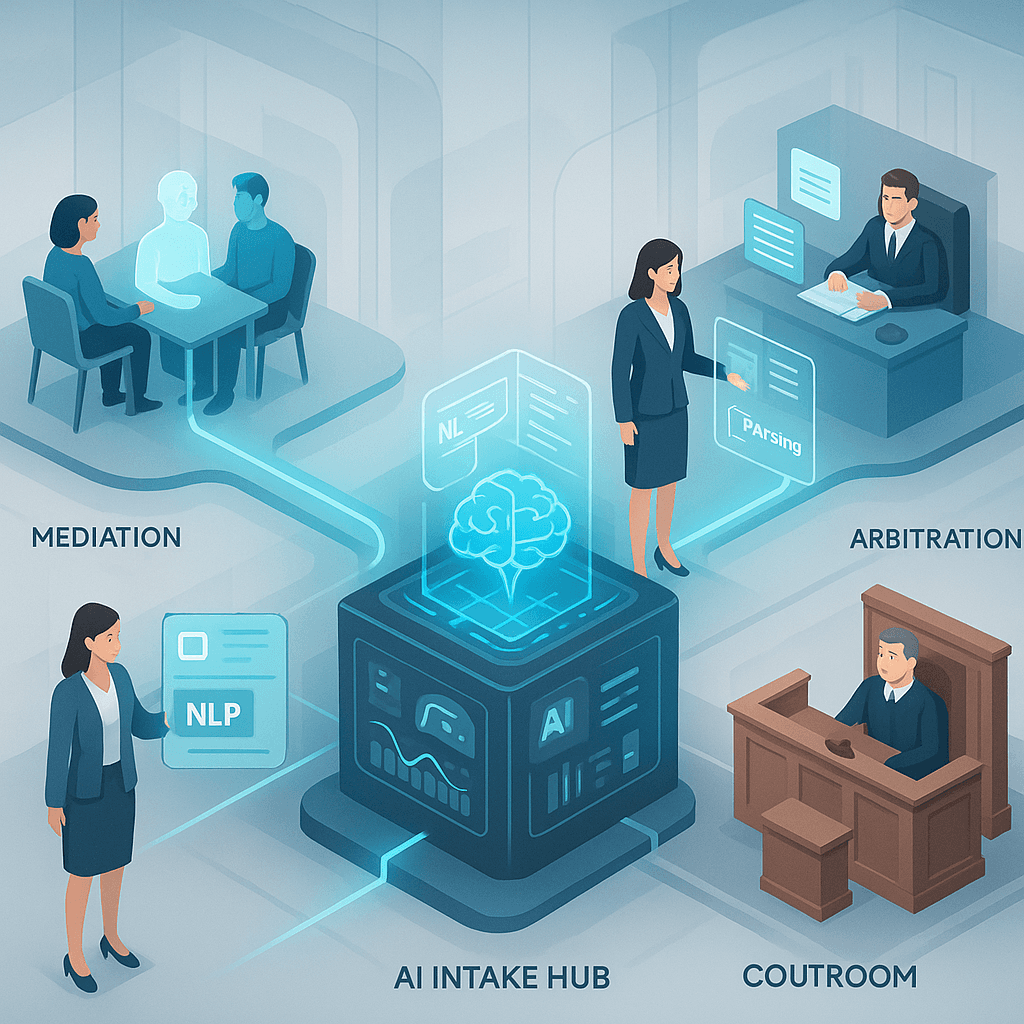
Mediation vs litigation intake AI solutions automate the identification and routing of client preferences at the very first touchpoint. Their power lies in AI intake mediation inquiries and related automation technologies that eliminate guesswork in triage.
How Mediation vs Litigation Intake AI Works
1. Natural Language Processing (NLP) and Understanding
Processes: Reads web forms, emails, call transcripts, chat logs. Learn about AI chatbots for law firm websites
Detects:
Explicit statements: "I want to avoid court", "I'm seeking mediation".
Indirect cues: "I can't afford a long trial", "We wish to preserve business ties".
Extracts:
Preferences, urgency, complexity, tone.
2. Decision Logic & Classification
Trained ML models analyze:
Past intake data.
Language patterns.
Case metadata (type, amount in controversy, industry).
Classification:
Routes instantly to mediation, arbitration, or litigation.
Continuously refines model as it processes more data.
3. Seamless Integration
With Case Management Software:
Populates relevant forms. See law firm automation software
Notifies the right department or attorney.
Aligns with scheduling and document automation tools.
4. Continuous Learning
Self-improving:
Adapts based on intake outcomes and staff feedback. Learn more about AI and machine learning for law firms
Learns new legal terms, slang, cross-jurisdictional nuances.
Impact
Removes manual misclassification.
Reduces intake-to-engagement times.
Provides actionable analytics for firm process improvement.
Empowers staff to focus on counseling, not paperwork.
Client Preference Routing Legal: Optimizing Routing with Mediation vs Litigation Intake AI
Client preference routing legal is the AI-assisted process that aligns intake with client needs, ensuring the chosen dispute resolution path reflects both stated and implied interests.
What is Client Preference Routing Legal?
Automated assignment of new inquiries to the dispute process matching the client’s outlined wishes, constraints, or sentiments.
Respects client autonomy by honoring explicit and implicit preferences.
Optimizes firm resources—only the right experts see the right cases.
How AI Delivers Preference-Based Routing
Sentiment analysis: Detects emotional language, urgency, hesitancy, or risk-aversion.
Interest detection: Uncovers indirect interests—e.g., desire to retain supply relationships.
Explicit wish matching: Instantly classifies inquiries with clear preference declarations.
Immediate Impact
Boosts client trust: Clients feel heard and respected.
Improves experience: Reduces bounce rates by sending relevant follow-ups.
Enables fast, accurate specialist allocation: Mediators, arbitrators, and litigators handle only suitable cases.
Example
A client notes, “I want this handled quietly and quickly.” AI flags this for arbitration or mediation preference over litigation.
Dispute Resolution Path Automation: Streamlining Workflows with Legal Resolution Method Detection
Dispute resolution path automation brings fundamental workflow improvements for legal operations, minimizing delays and error in the intake process while supporting robust legal resolution method detection.
How AI Automates Dispute Resolution Pathways
1. Real-Time Intake and Classification
Immediate triage: From days/hours to minutes/seconds.
Seamless assignment: Directs inquiries to correct internal process or professional.
2. Bottleneck and Error Reduction
Eliminates routing bottlenecks by handling higher volumes with no drop in consistency.
Reduces human oversight/fatigue errors that lead to costly mis-assignments.
3. Customized Follow-Up Plans
Mediation clients: Receive mediation process guides, mediator credentials, FAQs.
Arbitration clients: Provided with arbitration clauses, list of arbitral options.
Litigation clients: Sent court process timelines, cost estimates, and litigation FAQs. Learn about legal document automation tools
4. Direct Benefits
Faster client responses: Engagement rates and conversions climb.
Smoother case management: Less hand-off friction.
Higher client satisfaction: Demonstrates tailored attention from the outset.
References:
Bogin, Munns & Munns
Hartman Law
McGlone Law Office
HSAG Law
Arbitration Screening Tool Legal: Automated Screening for Arbitration Suitability
Arbitration screening tool legal solutions focus specifically on identifying cases especially suited for arbitration, enabling even more granular dispute resolution path automation.
Key Features of Arbitration Screening Tool Legal
1. Multi-Factor Screening
Complexity assessment: Cases too complex for mediation, but unsuited for lengthy court litigation.
Confidentiality needs: Detects requests for private, non-public hearings.
Speed/cost sensitivity: Flags cases where rapid, less expensive resolution is valued.
Industry/arbitration norms: Identifies sectors (e.g., tech, IP, international trade) where arbitration is standard.
2. Early Identification
Spots arbitration suitability at intake: Enables attorneys to discuss this option transparently with clients.
Integrates with cost calculators: Provides preliminary fee and timeline estimates.
…
FAQ
What is mediation vs litigation intake AI?
Mediation vs litigation intake AI refers to advanced artificial intelligence systems that analyze client inquiries at intake to determine and route cases to the most suitable dispute resolution method, such as mediation, arbitration, or litigation.
How does legal resolution method detection work?
It leverages natural language processing, machine learning models, and decision logic to analyze client communications, extract preferences, and classify dispute types, enabling automated routing to the ideal resolution pathway.
What are the benefits of AI in legal intake?
AI-driven intake reduces manual errors, speeds up lead classification, improves client satisfaction by matching preferences accurately, minimizes workflow bottlenecks, and frees staff to focus on advisory roles rather than paperwork.
What is client preference routing legal?
It is an AI-assisted process that respects both explicit and implicit client wishes during intake, automatically assigning inquiries to dispute resolution paths that align with client goals and optimizing firm resource allocation.
How can arbitration screening tool legal improve intake?
These tools identify cases best suited for arbitration early in the process through multifactor analysis, enabling targeted routing, better client advisement, and more efficient legal workflows.