Written by : Chris Lyle
Dec 11, 2025

Estimated reading time: 14 minutes
Key Takeaways
Multilingual legal disclaimers AI automates generation, translation, and delivery of legally compliant disclosures tailored by language, jurisdiction, and context.
Organizations must ensure legal disclosures are accessible and understandable to build trust and ensure enforceability.
AI legal automation reduces human error, enables scalability, and supports centralized, version-controlled content management.
Bilingual intake compliance legal solutions guarantee equivalency, legal meaning preservation, and proper use of translation disclaimers.
Language auto-detect legal chatbots provide frictionless, context-aware user experiences with dynamically adjusted disclaimers.
Implementing multilingual legal disclaimers AI successfully requires legal review workflows, transparency, deep workflow integration, and ongoing QA.
Table of Contents
Introduction: Why Multilingual Legal Disclaimers AI is Essential
The Need for Multilingual Intake Disclosures in Legal Settings
How AI is Revolutionizing Legal Language Compliance Automation
Features and Benefits of AI Regulatory Messaging Tools
Leveraging Bilingual Intake Compliance Legal Solutions
The Role of Language Auto-Detect Legal Chatbots in Intake
Best Practices for Implementing Multilingual Legal Disclaimers AI
Conclusion: The Essential Role of Multilingual Legal Disclaimers AI
FAQ
Introduction: Why Multilingual Legal Disclaimers AI is Essential
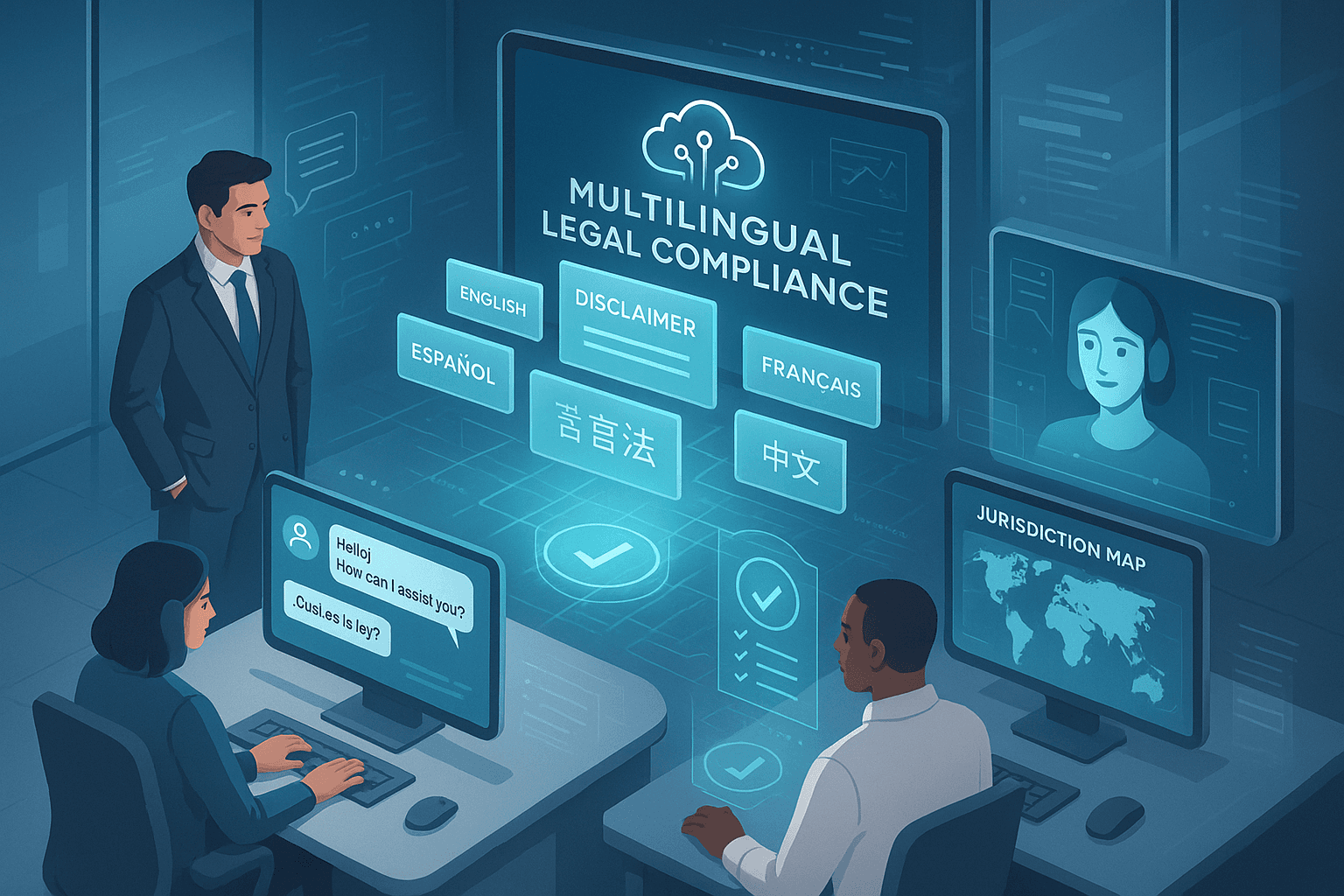
Multilingual legal disclaimers AI represents a new frontier in legal technology: AI-powered systems that automatically generate, translate, and deliver legally compliant disclaimers and disclosures in the user's language, across any digital intake channel.
This next-generation approach—sometimes called legal language compliance automation or multilingual intake disclosures—enables organizations to:
Meet and exceed regulatory requirements.
Build trust with users by ensuring information is accessible and understandable.
Efficiently scale legal intake and compliance processes for global, multilingual populations.
Organizations today face growing regulatory focus on language accessibility in legal communications. Compliance now goes well beyond merely displaying a disclaimer—organizations must present each disclosure in a language that the recipient truly understands, ensuring clarity and enforceability.
The challenges are considerable:
Maintaining and updating multiple languages and versions for every legal notice.
Synchronizing legal changes across jurisdictions.
Seamlessly integrating these updates into digital and automated workflows.
Addressing jurisdiction-specific and language-specific requirements—often on short notice.
Multilingual legal disclaimers AI provides a robust answer to these challenges. Properly implemented, it fundamentally transforms both compliance operations and the user experience. (source)
The Need for Multilingual Intake Disclosures in Legal Settings
What Are Multilingual Intake Disclosures?
At their core, multilingual intake disclosures are legal information—disclaimers, waivers, consents—presented in a language the user fully understands. This ensures clear, informed engagement and decision-making.
Key Purposes:
Informed consent: Users know exactly what they’re agreeing to.
Regulatory compliance: Laws require disclosures to be “clear and conspicuous”—which implicitly, and sometimes explicitly, means language accessibility.
User trust: Users are far more likely to trust content and agreements they understand.
Bilingual Intake Compliance Legal: Real-World Drivers
For many organizations, especially those serving populations speaking two main languages, bilingual intake compliance legal is paramount. Notably, this applies to environments where laws or user expectations demand equally authoritative legal content in both languages.
Industry Examples Where Multilingual Intake Disclosures Are Critical:
Healthcare: Informed consent forms, HIPAA notifications, medical waivers.
Financial Services: Loan agreements, risk disclosures, fee statements, KYC/AML consents.
Insurance: Policy terms, claim procedures, and exclusion statements.
Employment: Onboarding, arbitration agreements, workplace policies, benefits.
Government and Public Services: Benefits enrollment, immigration, housing applications.
SaaS / Marketplaces: Terms of service, privacy policies, AI-usage notices.
Risks of Not Using Multilingual Legal Disclaimers AI:
Legal challenge: Consents or contracts deemed unenforceable due to incomprehensible language.
Regulatory exposure: Fines, license suspension, or legal actions for failing to meet disclosure obligations.
Reputational risk: Loss of trust, negative publicity in underserved or misinformed communities.
The Bottom Line
Without robust, AI-driven systems for multilingual legal disclaimers AI, organizations face unnecessary legal, regulatory, and operational risks. Language accessibility isn’t only about inclusivity—it’s a pillar of enforceable, trustworthy client, patient, and user relationships.
(source)
How AI is Revolutionizing Legal Language Compliance Automation
Defining Legal Language Compliance Automation
Legal language compliance automation refers to using specialized technology to automate the generation, translation, delivery, and monitoring of legal text—such as disclaimers, consents, and notices—across channels, languages, and regions. /legal-ai-solutions
How Multilingual Legal Disclaimers AI Changes the Landscape
Traditional compliance approaches often rely on static templates, manual entry, and “after-the-fact” translation efforts—leading to costly errors and compliance gaps. Multilingual legal disclaimers AI disrupts this model with:
Advanced AI Translation and Generation
AI/ML language models drive context-based translation, capturing not just words but legal intent and nuance across languages.
Natural Language Processing (NLP) algorithms and large language models (LLMs) validate consistency, flagging ambiguous or inconsistent legal phrasing.
Automated Triggering and Routing
AI instantly determines the right disclaimer by user profile, jurisdiction, intake channel, or product.
No more manual selection or mismatched content.
Built-In Quality and Consistency Checks
Automated quality-control routines identify out-of-date or legally insufficient language.
Legal-specific glossaries minimize mistranslation and ensure critical legal definitions are preserved.
Transparent Audit Trails
Every version, language, and display event is automatically logged—crucial for audits and dispute resolution.
Benefits of Legal Language Compliance Automation
Fewer Human Errors: Automation drastically lowers risks of copy-paste mistakes or outdated text.
Scalability: Updates and additions are made centrally and immediately reflect across all channels/languages.
Consistent Compliance: Regulatory changes update universally, maintaining standardization.
Total Auditability: Every user sees the right disclaimer, in the right language, at the right moment—backed up by an immutable log.
AI translation with legal-specific glossaries ensures legal accuracy and consistency in every market.
(source)
Features and Benefits of AI Regulatory Messaging Tools
Core Features: AI Regulatory Messaging Tools
Today's AI regulatory messaging tools—with embedded multilingual legal disclaimers AI capabilities—present an integrated, futureproof solution for multilingual disclosures.
Dynamic Generation and Display
Disclaimers are rendered based on:
Jurisdiction (local, state, federal, or international).
Detected or user-selected language.
Product, risk level, or intake situation. /client-engagement-software-for-law-firm
Legal glossaries ensure translations are precise, capturing legal intent.
End-to-End Integration
Embed within:
Digital intake forms (web/apps).
CRMs and contact center apps.
E-signature/document automation flows.
APIs/webhooks allow real-time calls for the correct disclaimer based on the current user context.
Single Source of Truth
All legal content is version-controlled, centrally managed, and synced.
Any legal update propagates in real time across all languages and channels via the AI tool.
Reporting and Auditability
Built-in reporting dashboards show what was displayed, when, to whom, in which language.
Full audit trails support legal and regulatory reviews, and streamline dispute resolution.
Fast Response to Regulatory Change
AI-powered tools centralize update procedures.
Regulatory change triggers can instantly adapt required disclaimers and translation obligations.
AI can keep translations and updates in sync across all supported languages, ensuring nothing is missed.
(source)
Tangible Benefits
Consistency: One set of vetted legal disclosures, everywhere—no more content drift.
Speed: Respond to new or updated regulations fast, reducing rollout lag.
Risk Reduction: Lower risk of non-compliance penalties or outdated language.
Operational Efficiency: Slash manual review costs, reduce bottlenecks, and improve overall legal operations.
Leveraging Bilingual Intake Compliance Legal Solutions
The Role of Bilingual Intake Compliance Legal Tools
Organizations in bilingual environments (e.g., US: English/Spanish; Canada: English/French) have unique legal needs. Bilingual intake compliance legal modules within multilingual AI tools excel here:
Key Use Cases
Equivalence Assurance: Both language versions must be substantively identical.
Dual-Language Documents: Presenting both languages side-by-side as required by law or practice.
Centralized Review: Edits in the official language flag updates for review—and synchronized translation—for the second.
Challenges Addressed
High-fidelity translation: Avoids “false friends” and misinterpretations that generic translation engines often produce.
Legal meaning preservation: Specialized, legally trained models and glossaries ensure waivers, consents, or legal limitations are exact in both languages.
Official vs. Convenience Translation: AI flags which version is “governing” and can append translation disclaimers marking which takes precedence.
Legal-domain models and curated glossaries minimize the risk of loss/distortion of legal meaning, and best practices include translation disclaimers for proper enforceability.
(source 1 | source 2)
Applying Translation Disclaimers
Every translated legal document should clarify which language governs in case of dispute.
Disclaimers such as “This is a convenience translation; in the event of discrepancy, the original English version prevails” are incorporated automatically.
Outcome
Organizations dramatically reduce risk and ambiguity, ensuring that multi-language users (and courts) know precisely which terms apply.
The Role of Language Auto-Detect Legal Chatbots in Intake
Defining the Language Auto-Detect Legal Chatbot
A language auto-detect legal chatbot is an intelligent assistant that infers user language via message content or device/browser settings and converses in the detected tongue from the first point of contact. /ai-chatbot-for-law-firm-website
Intake Flow Enhancement
Detection: Instantly recognizes language, confirming with the user for accuracy if ambiguous.
Contextual Disclaimers: Delivers relevant disclaimers in the correct language at critical junctures (e.g., before collecting sensitive data or delivering legal advice).
Dynamic Adjustments: If the conversation changes to a higher legal risk (e.g., from general to personalized matters), the chatbot automatically injects more stringent or specific disclaimers.
User Benefits
Frictionless Experience: Removes the burden of manual language selection.
Accessibility: Serves users who may not speak, read, or write the default language fluently.
Context and Clarity: Only displays relevant disclaimers, improving clarity and reducing cognitive overload.
Power in Combination: Chatbots & Multilingual Legal Disclaimers AI
Orchestration: Chatbot manages the conversation flow, while the AI disclaimer engine provides the compliant, pre-approved legal text, personalized for language, jurisdiction, and context.
Synergy: Together, they increase compliance, accessibility, and user trust—while cutting staff workload and legal risk.
(source)
Best Practices for Implementing Multilingual Legal Disclaimers AI
How do leading organizations succeed with multilingual legal disclaimers AI, legal language compliance automation, AI regulatory messaging tools, and language auto-detect legal chatbot systems? The answer: follow a proven, process-driven approach.
1. Prioritize Accuracy and Legal Review
Let AI tools create drafts; legal professionals must review, approve, and update final texts. /ai-policy-for-law-firms
Select domain-specific legal-AI vendors—not generic translation providers.
Implement workflows where every translation and update passes through legal review before activation.
2. Centralized, Version-Controlled Content Management
Use a content management hub that holds all official legal text, per jurisdiction and language.
Link each translated version to its source for effortless tracking.
Maintain a full audit history—date, author, change notes—for each version.
3. Jurisdictional Compliance
Deploy rule engines to manage jurisdiction/product/risk-based disclaimer requirements.
Build the system for agility—rapidly enable, update, or sunset content as regulations shift.
4. Transparency and User Communication
Clearly mark:
All AI-generated responses.
All convenience translations vs. officially controlling text. /ethical-ai-use-law-firms
Use translation disclaimers:
Ex: “This translation is for convenience only; the English version controls in case of discrepancies.”
Place disclaimers in visible, consistent locations—above acceptance buttons or at beginning of chatbot conversations.
Best practice and emerging legal consensus support transparency through clear, visible translation and AI disclaimers.
(source 1 | source 2 | source 3 | source 4 | source 5)
5. Deep Workflow Integration
Leverage APIs to dynamically pull the correct language/jurisdiction disclaimer—never hard-code.
Integrate with all intake touchpoints:
Chatbots.
Web/mobile forms.
E-signature and document workflow tools.
Make the disclaimer engine context-aware (user, region, risk, time).
6. Continuous QA and Testing
Regularly test:
Language-detection accuracy.
Proper pairing of user/jurisdiction and displayed disclaimer.
Readability and legal sufficiency in all target languages. /automated-client-communication
Implement periodic review and governance cycles with legal, translation, and user experience experts.
Benefits
Regulatory peace of mind: Full compliance, documented by audit trails.
High user trust: Clear, accurate, accessible disclosures every time.
Operational efficiency: Streamlined processes prevent bottlenecks and errors.
Risk mitigation: Minimized exposure to legal/regulatory actions or reputation damage.
Conclusion: The Essential Role of Multilingual Legal Disclaimers AI
Multilingual legal disclaimers AI has become indispensable for organizations with diverse, global, or cross-language legal intake needs. It enables:
Flawless legal language compliance automation—across borders, platforms, and languages.
Highly adaptive AI regulatory messaging tools—instantly responding to new legal requirements.
Seamless user journeys—where disclaimers and consents are always clearly communicated, in any language, at every point of interaction.
Benefits at a Glance:
Ironclad regulatory compliance, including fast adaptation to new AI and disclosure rules.
Enhanced end-user experiences—greater trust, clarity, and inclusivity.
Mitigation of legal and operational risks—reducing the possibility of missed requirements, unenforceable agreements, or negative publicity.
Full auditability and centralized, scalable control across all legal disclosures.
Take Action Now
Legal, compliance, and operations professionals: it's time to modernize your intake and compliance strategy. Leverage the power of multilingual legal disclaimers AI—paired with best-in-class legal review—to ensure you meet every regulatory requirement while building trust with every client, patient, or user.
Ready to see this in action? Book a demo of LawHustle’s industry-leading multilingual legal disclaimer and chatbot platform today.
FAQ
What is multilingual legal disclaimers AI?
Multilingual legal disclaimers AI is an AI-powered system that generates, translates, and delivers legally compliant disclaimers and disclosures in the user's language, ensuring accessibility and compliance across digital intake channels.
Why are multilingual intake disclosures important in legal settings?
They ensure users fully understand legal notices and consents in their own language, which is critical for informed consent, regulatory compliance, enforceability, and building user trust.
How do AI chatbots enhance legal intake?
Language auto-detect legal chatbots automatically determine the user's language, provide context-aware disclaimers, and dynamically adjust disclosures to match legal risk, delivering a frictionless and compliant user experience.
What are best practices for implementing multilingual legal disclaimers AI?
Key best practices include prioritizing legal review, centralized content management, jurisdictional compliance, transparency with AI and translation disclaimers, deep workflow integration, and continuous QA and testing.
How do translation disclaimers work?
They clarify which language version governs in case of dispute, often with messages like “This is a convenience translation; in the event of discrepancy, the original English version prevails,” helping reduce ambiguity and legal risk.